Automatic Fish Feeder: Drum or Wheel, and Which Clumps
September 17, 2026
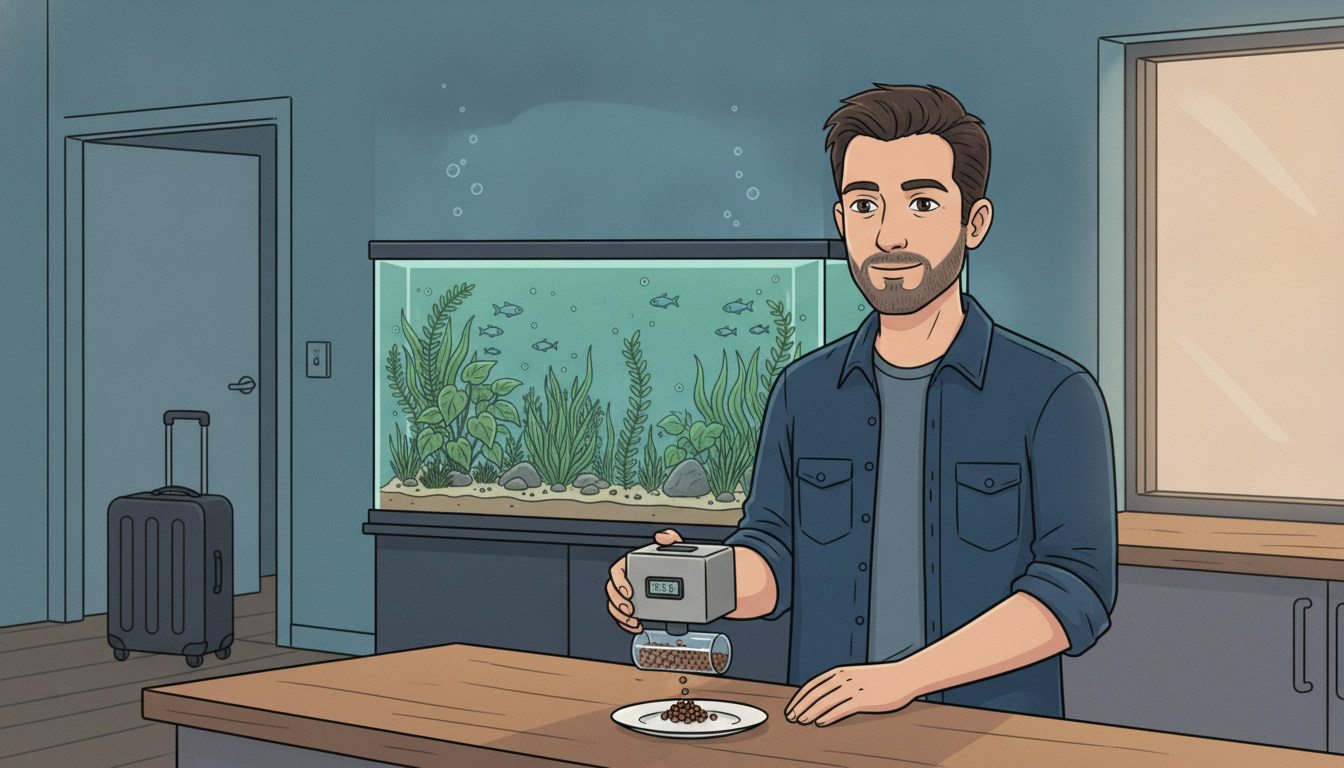
An automatic feeder can fail you in two ways. It can skip meals. Or it can dump a pile of food into the tank all at once.
Those two sound like the same kind of problem. They aren’t even close.
A tank that misses a few meals is fine. Healthy adult fish can go days without food and come out of it hungry and completely normal. A tank that gets a week of food in one afternoon is in real trouble, because food nobody eats doesn’t just sit there. It rots, and rotting food turns into ammonia, and ammonia in a tank with nobody home to do a water change is how you come back to a cloudy tank and dead fish.
So when I pick and set up a feeder, I’m not trying to make it perfect. I’m trying to make sure that if it fails, it fails toward skipping. Everything below comes from that one idea.
Why feeders clump — and why clumping causes both failures
Here’s what’s going on above your tank.
Warm water gives off moisture all day. That damp air rises, and a feeder mounted on the rim sits right in it. Some of that moisture gets inside the food container. When the room cools off a bit at night, more of that moisture ends up on the food.
Flakes are the worst food for this. They’re thin, dry, and they soak moisture up fast. Damp flakes stick together, and a sticky mass of flakes can form a bridge right over the feeder’s opening. The drum turns, nothing falls out. That’s your skipped meal.
Now the part people don’t expect. That clump doesn’t stay stuck forever. Sooner or later it breaks loose, and when it does it falls out as one big lump — several meals’ worth of soggy flakes at once. So the same humidity problem gives you a skipped meal on Tuesday and an overfeeding on Thursday.
The fix starts with the food. Use small, dry pellets or granules in a drum feeder, not flakes. Pellets are denser and they don’t mat together the way flakes do, so they keep flowing. Eheim’s own manual lists flake food and granules as what their feeder is built for, so you’re not doing anything unusual by picking the granules.
One correction to advice you’ll see around: “use wafers.” Plenty of drum openings are too small for a full-size wafer, and a wafer wedged in the slot is its own jam. Stick to small pellets or granules that fit the opening easily.
Drum feeders vs. wheel feeders
There are two basic designs, and they fail in different ways.
A drum feeder is a clear container that turns on a small motor. There’s a slot in the side with a slider that sets how wide the opening is. At feeding time the drum rotates, some food falls out of the slot, and the drum turns back. The Eheim Everyday and the Aquarium Co-Op Auto Feeder both work this way.
The good side: a drum holds a lot of food, so it can cover a long trip. It can feed up to four times a day. And it can put out a very small portion, which matters for small fish.
The weak side: the portion isn’t fixed. It depends on how freely the food flows out of the slot. Change the food, get some humidity in there, or bump the slider, and the amount that falls out changes too.
A wheel feeder has a row of separate compartments on a turning wheel, one meal in each. At feeding time the wheel moves one slot forward and that compartment empties. The Fish Mate F14 is the common one, with 14 compartments.
The good side: you put each portion in by hand, so the portion is exactly what you loaded. It can’t drop more than one compartment at once. That’s a hard cap on the dumping problem, built into the machine.
The weak side: it runs out. Fourteen compartments is fourteen meals, which is two weeks at one meal a day, or one week at two. And it doesn’t solve humidity — food sitting in a compartment above warm water can still get damp.
My call: for most people, get a drum feeder, set it up the way I describe below, and test it. You get more runway and finer portions. Go with a wheel if your trips are two weeks or shorter, your fish eat once a day, and the fear of a dump is what’s keeping you up at night.
Set the opening by measuring, not guessing
You’ll see advice to set a feeder to some exact percentage of a normal meal. I don’t trust a number like that, because a drum turn doesn’t measure food in percent. It measures food in “whatever fell out of the slot.” So measure that.
- Fill the drum with the food you’ll actually travel with.
- Set the slider narrow.
- Hold the feeder over a white plate or paper towel and press the manual feed button. Do it five times.
- Look at what landed. Is each turn about the same? If one turn drops a clump and the next drops nothing, your food is the problem, not the slider.
- Compare a single turn to what your fish clean up in a minute or two when you feed by hand. Set it smaller than that.
Smaller is the direction you want. A fish that eats a bit less for two weeks is fine. Uneaten food sinking into the gravel every single day is not.
Then set it for one feeding a day. If you need a bit more, use a second turn rather than opening the slot wider. The Eheim can do a double turn at a single feeding time, a minute apart, which gives you more food without a bigger opening for clumps to fall through.
Batteries: the boring part that decides everything
Every feeder in this post runs on a battery, and that’s the point. A feeder that plugs into the wall stops feeding the moment the power goes out, which is exactly the moment you aren’t there to notice. I cover that in more detail in my under-$100 automation stack.
But “battery-powered” only helps if the battery is good. Each of these handles it a little differently:
- Eheim Everyday: two AA alkaline batteries. The manual is clear that you should not use rechargeables. When the batteries get low, the screen shows LO. About three days later the feeder shuts itself off on purpose, so that the drum isn’t left stopped with the opening facing down. That’s a feeder designed to fail toward skipping, which is exactly what you want.
- Aquarium Co-Op Auto Feeder: a built-in rechargeable battery that lasts three to six months depending on how often it feeds. It charges over USB-C in about three hours, and you can leave it plugged in all the time if you like.
- Fish Mate F14: one AA battery that runs for over a year.
My rule is simple. Fresh batteries or a full charge before every trip, no matter what the low-battery light says. A pair of AAs costs less than one fish.
Where you mount it matters more than you’d think
Put the feeder over a patch of open, calm water, and keep it clear of two spots.
Anywhere the water splashes or bubbles. The filter outflow throws droplets and damp air right at the feeder, and an air stone does the same thing more quietly — every bursting bubble puts a little mist into the air above the water. It’s the fastest way to get wet food.
The filter intake. If food lands right where the current pulls it into the filter, your fish never get it. It just rots inside the filter instead of in the gravel.
Eheim’s manual also says the air intake on the back of the unit shouldn’t sit in the damp air over an open tank. So if you have a lid with a feeding hole, use it, and keep the body of the feeder outside the lid. If you have an open-top tank, mount it on the rim with the drum hanging over the water and the motor side toward the room.
Tell your house sitter not to feed the fish
This one isn’t about the machine at all.
If someone is checking on your place, there’s a good chance they’ll see the fish, feel bad, and feed them. Then the feeder feeds them too. That’s the human version of a feeder dump, and it’s more common than any mechanical failure.
Tell them straight out: the fish are fed by the machine, don’t add food. If they’re worried the feeder has stopped, ask them to text you instead.
Test it before you trust it
None of this counts until you’ve watched it work.
Load the feeder, set it the way you’ll leave it, and let it do every meal for a full week while you’re still home. Don’t hand-feed on top of it. Look inside the drum every couple of days for clumps. Check that the plate test still matches what’s falling into the tank. I walk through the whole week in the 14-day vacation test.
If it skips a meal during that week, good. You found it now, with time to switch food or move the feeder. That’s far better than finding out when you get home.