Aquarium Too Hot? Your Fish Suffocate Before They Cook
October 6, 2026
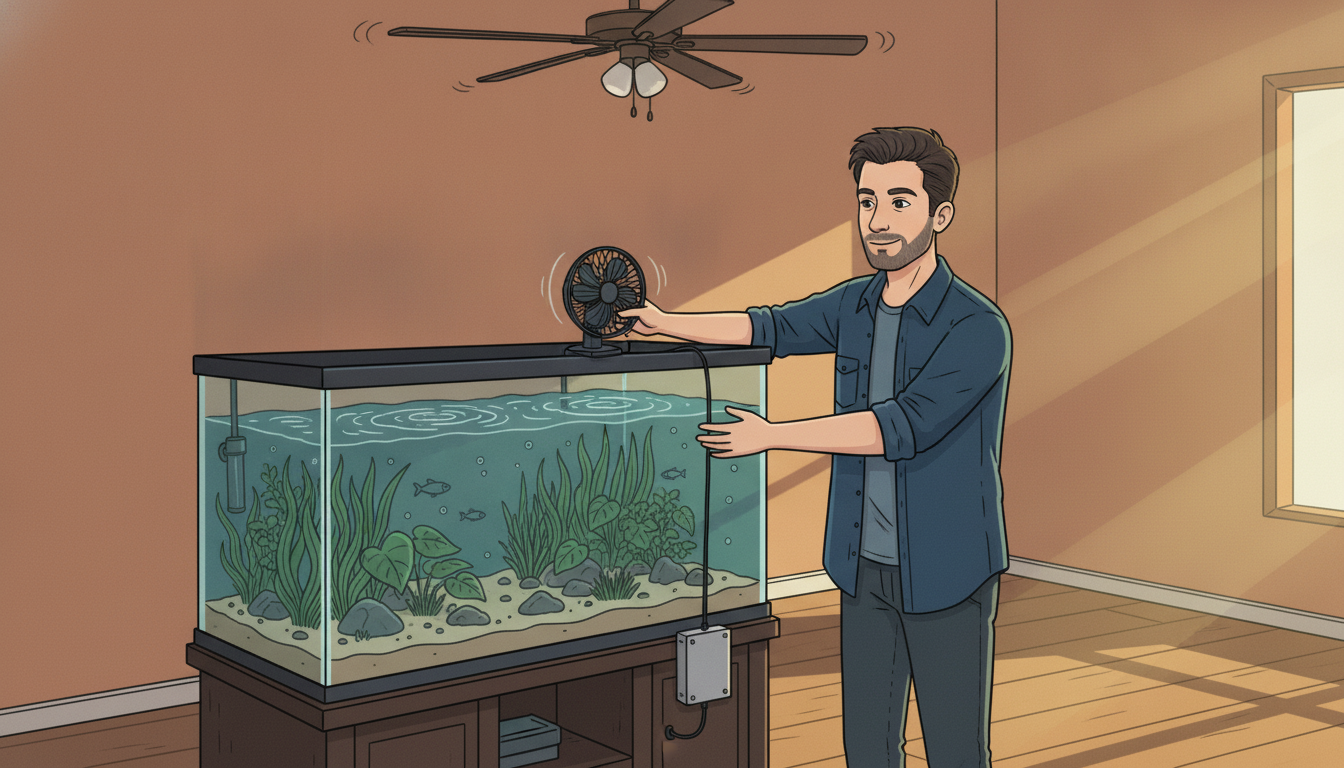
Every post on this site watches the tank get cold.
Heater wattage. Outage fail-safes. A monitor that texts you when the heater quits. Twenty-odd pieces, all of them pointed at the same direction of failure, because that’s the one that scares people in a Winnipeg February.
Then last July a reader wrote in from a house with the air conditioning switched off for two weeks, and I realised I’d never once written the other half. The tank didn’t get cold. It got hot, and it kept getting hotter, and nothing in anyone’s setup was watching for that.
Here’s the thing I got wrong for years. I thought of overheating as a slow version of the same problem — the temperature drifts, the fish get stressed, you fix it when you get home. It isn’t a slow version of anything. Hot water takes oxygen away from fish at the exact moment their bodies start demanding more of it, and that’s a much faster failure than being a few degrees cold.
Hot water is an oxygen problem wearing a temperature costume
Two things move when your tank warms up, and they move in opposite directions.
The water can hold less oxygen. This is just physics, and it’s tabulated. YSI publishes the standard solubility table for oxygen in fresh water at sea level: at 26 °C (79 °F) the water can hold 8.11 mg of oxygen per litre, and at 32 °C (90 °F) it can hold 7.31 mg. So a six-degree climb takes about 10% of the ceiling away. Not catastrophic on its own. Hold that thought.
The fish need more oxygen. Fish don’t make their own heat. Their body temperature is the water’s temperature, which means the water sets the speed of everything happening inside them. A 2020 review of temperature and fish physiology in the journal Temperature (Volkoff and Rønnestad) puts the figure plainly: uncompensated, metabolic processes run two to three times faster for every 10 °C increase. That’s the Q10 coefficient, and the same review is careful to note it isn’t a fixed number — it usually gets smaller at higher temperatures.
Run that six-degree climb through the gentle end of that range and the fish are asking for roughly half again as much oxygen as they were. Through the steep end, nearly double.
So: supply down ten percent, demand up fifty to ninety-five. That gap is the whole story, and it’s why “my tank hit 32 and the fish were gasping at the surface” is such a common thing to read and such a confusing thing to experience. Thirty-two degrees won’t cook a tropical fish. The fish wasn’t too hot. It was out of air.
The same review has a second finding that matters more for a tank you’ve left alone. As water warms, a fish’s resting metabolism keeps climbing, but its maximum capacity flattens out and then falls. The gap between the two — everything spare it has for digesting, swimming, healing, dealing with a surprise — closes. A hot tank doesn’t just stress fish. It takes away the margin they’d normally use to survive the next thing that goes wrong, which in a house with nobody home is a real consideration.
What a number on the thermometer actually tells you
I’m not going to hand you a per-species table, because the honest ones live in academic papers and the convenient ones are hobby sites quoting each other.
What I’ll give you instead is the shape of it. Most community tropicals are kept somewhere around 24–27 °C (75–81 °F). Trouble in those tanks isn’t a line you cross at a specific degree — it’s the gap above widening until the fish can’t close it. Which means the two things worth knowing about your own tank are: how high does it actually go on a hot day, and how fast does it climb?
Find out before you need to know. Leave a thermometer in and read it at 5 p.m. on the hottest day you get, which is a couple of hours after the room peaks and well after the lights have been dumping heat into the water all afternoon. That reading is your real baseline. Everything below is sized against it.
And check your lights while you’re at it. On a lot of tanks the biggest heat source in the room isn’t the room — it’s the fixture sitting two inches above the water for eight hours a day. If your tank runs hot, shifting the photoperiod to the cool part of the day costs nothing and is already on a timer, which the lighting post gets into for other reasons.
The fan, and why it’s the right tool
A fan blowing across the surface cools water by making it evaporate. Water leaving as vapour takes heat with it, and the water that stays behind is cooler. That’s it — it’s the same reason you feel cold getting out of a lake.
Two things follow from that, and both matter more than the fan you buy.
The drier the air in the room, the more water can evaporate, so the more the fan cools. In a dry prairie house in July you’ll get a real drop. In a humid basement you’ll get much less, and no fan can fix that, because there’s nowhere for the vapour to go.
I’m not going to quote you a number of degrees. I went looking for one, and what I found was retail blogs and forum threads citing each other, ranging from one degree to ten, with no measurements behind any of it. Measure your own instead, which takes an afternoon: read the tank, run the fan for three or four hours on a hot day, read it again. Now you know what your fan does in your room, which is the only version of that number that’s any use to you.
Aim it along the surface, not down at the glass. You want air moving across the whole top of the water, carrying vapour away as it forms. A fan pointed at the side of the tank mostly rattles.
The lid decision, stated honestly
Here’s where I have to contradict two other posts on this site, so let me do it out loud rather than quietly.
Evaporation needs an opening. The generic advice is “take the lid off,” and if you’re standing in the room on a hot afternoon, fine. For a tank nobody is watching for two weeks, taking the lid off is a bad trade, and I’ve written both halves of why:
- An open top is an exit. Mystery snails climb out through gaps — the cord notches, the filter cutout, anywhere the lid doesn’t quite seal. Plenty of fish jump too. A dead snail on the floor on day three is a worse outcome than a tank running two degrees warm.
- An open top evaporates much faster, on purpose. That’s the point of the fan, but evaporation is exactly what the auto top-off post is about: only pure water leaves, every mineral stays behind, so your GH, KH and TDS climb the whole time the level drops. Fan-cooling a tank for two weeks with no top-off means coming home to a lower, harder tank than you left.
So the answer isn’t open or closed. It’s mesh.
A screen lid keeps snails and jumpers in and lets vapour out. It’s the only option that doesn’t force you to pick between the two failures. If you’ve only got a glass canopy, leave it on and run the fan across whatever gap already exists at the back for the cords — you’ll get weaker cooling, and that’s the correct trade for a tank you can’t supervise.
Then budget for the water. If the fan is going to run, the top-off reservoir has to be sized for fan-driven evaporation, not normal evaporation, and that’s a bigger jug than you think. No top-off at all? Then the fan should be a last resort on the controller rather than a thing that runs daily, and you lean harder on the next section.
The cheapest real fix is air, not cold
If hot water is an oxygen problem, the direct answer is to put oxygen back.
Almost all of the oxygen in a body of water arrives at the surface where moving water meets air. The FAO’s aquaculture water-quality material makes the point with a number I think about a lot: by still diffusion alone, oxygen would take roughly six years to work its way down six metres of quiet water. Essentially all real oxygen enrichment comes from agitation. Not from the water being cold. From the surface being broken up.
Which means a $15 air pump is doing something no amount of cooling does. It doesn’t lower the ceiling-raising temperature, but it drives the tank up against whatever ceiling it has, continuously, and it keeps doing it at 32 °C. On a hot-tank problem it’s the highest-value thing you can plug in, and it’s the piece most people skip because it feels too simple to count.
Run it all summer. Not just when it’s hot — the pump costs 4 watts and you’ll never think about it again. And if you’ve read the power-outage post, you already know surface agitation is the clock that runs out first in a blackout; this is the same lever, for a different emergency.
Setting the alarm, and the limit nobody mentions
The controller is what turns all of this from advice into a system. One box, one probe, a heating outlet and a cooling outlet. In winter it runs the heater. In July it runs the fan. You set a target and a tolerance and then you stop thinking about it.
Set the high alarm. Genuinely — go into the menu and set it. Most people configure the heating side, see the display hold steady, and never touch the alarm settings, which means the one feature designed to tell you something has gone wrong is sitting at whatever the factory picked.
But here’s the limit, and I’d rather say it than sell past it: it’s a buzzer. Inkbird’s listing is upfront about that. A buzzer beeping in an empty house is a philosophy problem, not a fail-safe. The alarm catches the problem on a Tuesday when you’re in the next room. It does nothing for you on day six of a trip.
For that you need something that can reach you, which is a different box. The WiFi monitor post covers that side — and it was written for heater failure, watching the cold direction. If you set one up, set the high threshold too. Mine was watching one direction for a year before I noticed.
That’s the honest division of labour. The controller acts without you. The monitor tells you. Neither one does the other’s job, and a lot of people buy the first and assume they got the second.
The same controller is the one the heater post recommends for rooms that get hot, which is not a coincidence — the reason to pick the dual-stage unit over the heating-only one is precisely the summer you’re reading this for.
What not to do from a thousand kilometres away
The generic cooling advice assumes a person in the room, and some of it turns dangerous the moment nobody’s there.
No floating ice. Not because ice is wrong — it works fine if you’re standing there watching the thermometer. But it’s a manual, one-shot intervention that ends when it melts, and it drops the temperature in a lurch. A fast swing is its own stressor on top of the heat you’re trying to fix. A fan holds a temperature; ice pokes at one.
Don’t chase it with a big setpoint change. If you’re logged in remotely and the tank reads 31, resist dialling the controller down four degrees to “catch up.” Cooling faster than the room allows isn’t something the fan can do anyway, and the only thing you’ll accomplish is running it flat out.
Don’t tell a neighbour to do water changes. Cool tap water into a hot tank, in a volume someone else is judging, is how a heat problem becomes a shock problem. If you’ve got someone checking in, give them one job: look at the number and text you. The mock-vacation week is where you find out whether the system holds without them.
Keep feeding light. Warm water speeds up digestion and waste processing, and both burn oxygen you’re already short of. A lighter feed schedule in a heatwave isn’t deprivation; it’s the same logic as understocking a tank so it forgives your absence.
When a chiller is the honest answer — and why there’s no link to one
Sometimes a fan isn’t enough, and I’d rather say so than pretend the cheap fix always works.
If you keep anything that genuinely needs cool water — axolotls are the usual case — in a room that bakes, evaporative cooling is not a solution. It can only move you a few degrees off the room, and if the room is the problem by ten, you need refrigeration.
But I’m not putting a buy button on one, and here’s the reasoning. I went through what’s actually on the shelf for aquarium chillers: mostly unfamiliar brands, review averages sitting in the fours and high threes, and a 1/10 horsepower unit rated for all of 42 gallons. A chiller is a compressor and a pump — a real appliance, with its own failure modes, plumbed into your tank. This whole site exists on one rule, which is that I won’t put a flimsy single point of failure in charge of a tank nobody’s watching. A budget chiller on a two-week absence is exactly that.
So: if you need a chiller, you need a good one, you should buy it from somebody who’ll support it, and you should run it through a mock week at home before it’s ever the thing standing between your fish and a heatwave. That’s a real recommendation. It just isn’t one I can make by pointing at a listing.
The whole thing, in order
If your tank runs hot and you’re going away:
- Read your tank at 5 p.m. on the hottest day you get. That’s your baseline.
- Shift the lights to the cooler part of the day. Free, already automated.
- Put an air pump in and leave it running. Cheapest fix, treats the actual problem.
- Get a mesh lid, or keep the glass one on and accept weaker cooling.
- Put the fan on the controller’s cooling outlet, aimed along the surface.
- Set the high alarm. Then accept that it’s a buzzer and add something that can reach you.
- Size the top-off reservoir for fan-driven evaporation, not normal evaporation.
- Run it for a week while you’re still home, and watch what the numbers actually do.
Step eight is the one that matters. Everything above is a guess until you’ve watched your own tank do it with you standing there.