Auto Top-Off for a Freshwater Tank: The Build That Works
September 8, 2026
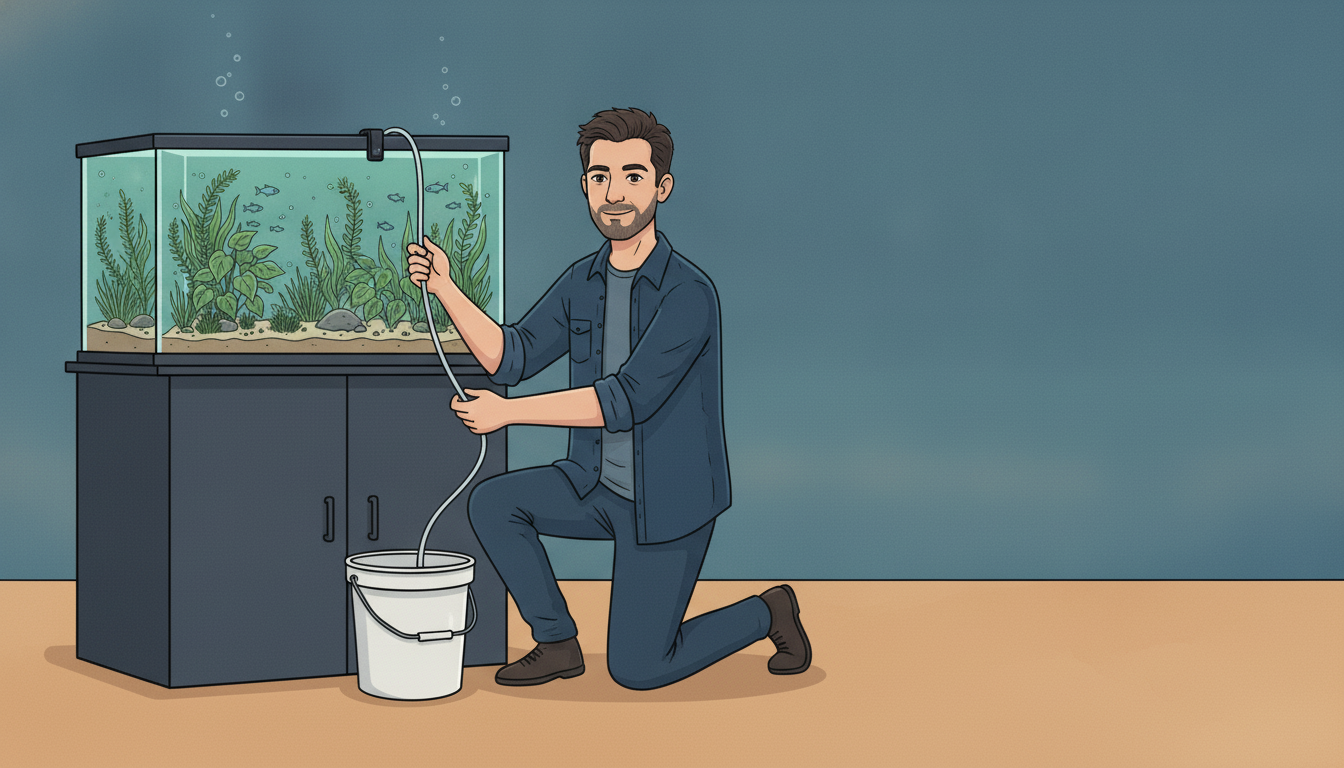
Here’s a small disaster I’ve watched happen to other people. You leave for two weeks. The tank looks fine when you go. You come home and the water line has dropped an inch and a half, the heater’s top coil is half out of the water clicking on and off, and the filter intake is sucking air. Nothing died — this time. But the tank spent your whole trip stressed, and you never touched a drop of water to cause it. That’s evaporation, and an auto top-off fixes it for good.
I think a lot of freshwater keepers skip ATOs because they assume it’s a reef-tank thing. It isn’t. The reef crowd got there first because saltwater makes evaporation impossible to ignore, but the physics are identical in your planted tank. Water leaves as vapor. Everything dissolved in it stays behind. An ATO just replaces what left, automatically, before it becomes a problem.
Let me walk through the whole build the way I’d set it up myself.
Why a dropping water level is a real problem, not a cosmetic one
Two things get threatened when the level falls, and neither is about looks.
First, your equipment. Heaters are built to run underwater — that water carries the heat away. Let the level drop past the heater and the top of it runs hot and dry, which is exactly how a heater cracks or fails on. Your filter intake has the same problem: drop below it and the pump starts pulling air, flow tanks, and your biological filter quietly starves.
Second — and this is the freshwater-specific part — your water chemistry drifts. When water evaporates, only pure water leaves. Every mineral stays in the tank. So as the level falls, your GH, KH, and general dissolved solids all creep up, concentrating a little more each day. Top the tank back off with pure water and you reset that. Ignore it for two weeks and you’ve slowly hardened your water without meaning to.
An ATO holds the level steady, so both problems just never start.
Optical sensor vs. float switch — pick your failure mode
Every ATO decides “the water’s low, add some” using one of two sensor types, and they fail in different ways. This matters more than the brand.
A float switch is mechanical: a little float rides up and down on a stem and flips a circuit. It’s cheap and dead simple. The catch is that anything physical can jam it — a snail parks on it, biofilm gums the stem, mineral scale builds up — and a stuck float either stops topping off or, worse, keeps the pump running.
An optical sensor uses a beam of infrared light inside a small prism to “see” water. No moving parts to stick, and it’s accurate down to a millimeter or two. Its weakness is the lens: heavy algae film, or a cloud of micro-bubbles clinging to it, can fool it.
Here’s the rule I actually follow: don’t trust a single sensor of either kind to run unattended. The good packaged units use two sensors — a primary that does the topping off and a fail-safe mounted just above it that cuts everything off if the water ever climbs too high. Redundancy is the whole point of leaving a machine in charge while you’re gone. One sensor is a gadget. Two sensors is a fail-safe.
The one thing freshwater guides get wrong: use pure water
This trips people up, so I’ll be blunt. Your top-off reservoir should hold pure water — RO/DI or distilled — not tap water, and not remineralized water.
The logic follows straight from the evaporation section. Only pure water evaporated out, so only pure water should go back in. If you top off with tap water, you’re adding a fresh dose of minerals on top of the ones already left behind — and over weeks of automatic topping, your GH, KH, and TDS climb until the water’s genuinely too hard for your fish. It happens slowly and invisibly, which is what makes it dangerous.
Water changes are where you replace minerals and export waste. Top-off is only for replacing evaporated water. Keep those two jobs separate and your parameters stay flat, trip after trip.
Wiring it so it can’t flood your house
The scariest failure mode isn’t the tank going low — it’s the reservoir emptying onto your floor. Two safeguards prevent it.
The big one is siphon prevention. If your reservoir sits higher than the tube’s outlet in the tank, water can start a gravity siphon and keep flowing long after the pump shuts off, draining the whole reservoir into your tank until it overflows. The fix is simple: make sure the output tube sits above the highest water level the reservoir can reach, or fit an anti-siphon valve (the packaged kits include one). Get this right once at setup and it’s handled forever.
The second is a run-time watchdog, which the better controllers build in. It watches how long the pump runs on a normal fill; if the pump ever runs way longer than usual — a sign a sensor’s stuck or the tube popped loose — it shuts the pump off and alarms instead of pumping your reservoir dry. That’s the feature I’d pay for on a unit I leave running while I’m three time zones away.
Sizing the reservoir for the length of your trip
Match the reservoir to how long you’ll be gone and how fast your tank evaporates. A good target is a container that holds roughly one to two weeks of your tank’s evaporation — for most mid-size tanks that’s a covered 5-gallon jug or bucket. Keep it covered so the reservoir itself doesn’t evaporate or grow anything.
One safety note on going big: don’t put a giant reservoir on a small tank. If a sensor ever fails wide open, you never want more water sitting in the reservoir than your tank can physically hold. On a nano, a modest jug is safer than a 20-gallon drum. Size for your absence, not for the biggest container you own.
DIY or buy the packaged unit?
You can absolutely build one: a float switch, a small pump, a length of tubing, and a bucket will top a tank off for cheap. I’ve done it. The honest problem is that a bare DIY rig is usually a single point of failure — one sensor, no run-time watchdog, no second opinion — which is the exact thing you don’t want babysitting your tank while you’re on a plane.
For a tank I leave for weeks, I want the redundancy built in, and that’s what the packaged units sell. The AutoAqua Smart ATO Duo is the one I’d hand most freshwater keepers first — two optical sensors, a run-time cutoff, compact enough to hide on a rimless tank, and priced like a sensible upgrade rather than a luxury. If you’re running a big display or a sump and want a controller that’ll outlast the tank, the Tunze Osmolator 3 is the buy-it-once move: an optical sensor backed by an independent thermal safety sensor and a strong pump that’ll push water from a reservoir across the room.
Either way, the outcome is the same, and it’s the whole reason I run one. The level never moves. The heater stays under water, the intake stays fed, the chemistry stays flat — and “top off the tank” drops off my pre-trip checklist entirely. For a setup built to run itself while you’re away, that’s exactly one less thing that can go wrong.