Can a Fish Tank Go a Month Without a Water Change?
September 8, 2026
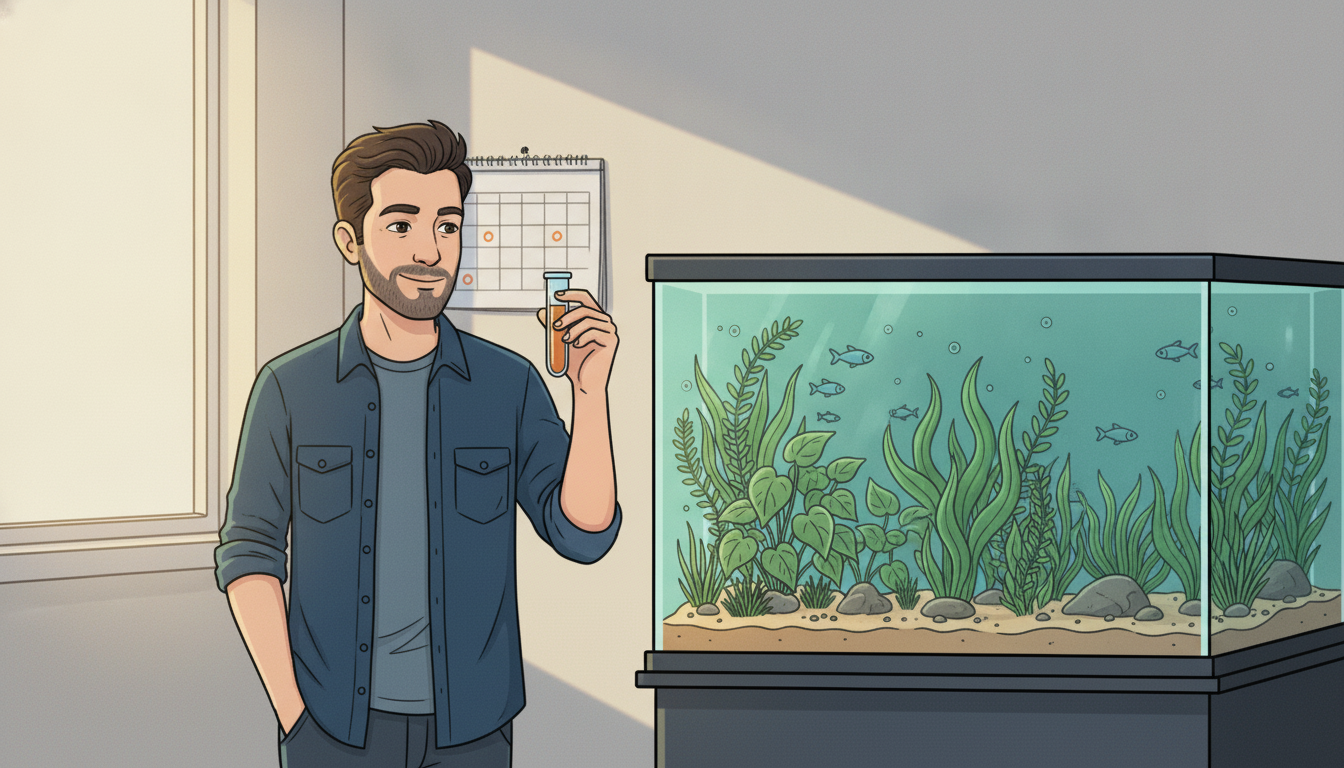
Ask this question in any aquarium group and you’ll get two answers within about ninety seconds.
“Weekly. No excuses. 25% minimum.”
“I haven’t done a water change since 2019 and my fish are fine.”
Here’s the annoying part: both of those people are probably telling the truth about their own tanks. And neither answer helps you, because a water change isn’t a ritual you owe your fish. It’s a correction. How often you need one depends entirely on how fast your particular tank drifts out of range — and that speed is something you can measure, and mostly something you can change.
So let’s actually work it out.
What a water change is really doing
Three jobs, and only one of them is the famous one.
It dilutes nitrate. Fish waste turns into ammonia, bacteria turn ammonia into nitrite, other bacteria turn nitrite into nitrate. Nitrate is the end of the line. Your filter can’t remove it. Plants eat some of it, but in most tanks it just piles up until you take water out and put clean water in.
It removes the stuff you can’t test for. Dissolved organic compounds, hormones, leftover proteins, tannins from breaking-down plant matter. There’s no test kit on the shelf for most of it. It’s the reason a tank with perfect numbers can still look slightly yellow and smell tired.
It puts minerals back. This one gets missed constantly. Your fish and plants consume calcium and magnesium (that’s GH, general hardness) and your tank slowly burns through KH — carbonate hardness, which is the buffer that stops your pH from moving. Evaporation makes it worse in reverse: water leaves, minerals stay, and everything left behind gets more concentrated.
A water change resets all three at once. That’s why it’s the default advice. It’s a blunt tool that fixes several problems you might not have diagnosed.
The five levers that set your number
Your tank’s drift speed comes down to these, and you control every one of them.
1. Stocking level. The single biggest lever. Waste in equals nitrate out. A 75-gallon with a dozen small tetras and a few corys produces a fraction of what the same tank does packed with cichlids. Half the fish, roughly half the drift.
2. Plant load. This is the one that turns “two weeks” into “two months.” Fast-growing plants — hornwort, water sprite, floaters like frogbit and duckweed — pull nitrate out of the water as food. A genuinely heavily planted tank can hold nitrate flat or even drive it down. Slow-growers like anubias and java fern look great but barely move the needle. If you want a long window, you need growth, not just greenery.
3. Water volume. More water is more dilution. A 10-gallon tank with six fish hits trouble far faster than a 55-gallon with six fish, because the same waste is spread across five times the water. Volume is a shock absorber. This is why I keep telling people the bigger tank is the easier tank, which sounds backwards until you’ve done both.
4. Feeding. Every flake you drop in becomes waste, whether a fish eats it or not. Overfeeding is the fastest way to shorten your window, and it’s also the easiest thing to fix. An auto-feeder set slightly light while you’re away is doing double duty — feeding your fish and protecting your water.
5. Filtration and flow. Filtration doesn’t remove nitrate, so it doesn’t directly extend the window. What it does is keep the front end of the cycle from backing up, so waste gets processed instead of rotting. Good flow also keeps oxygen up, which the bacteria need to do their job at all.
What the drift actually looks like
Numbers vary a lot, so treat these as shapes, not promises. Measure your own tank — that’s the entire point of this post.
A moderately stocked community tank with a few undemanding plants typically climbs somewhere around 5 to 10 ppm of nitrate per week. Start at 10 ppm after a change, and two weeks later you’re sitting around 20 to 30. That’s fine. Four weeks in, you’re pushing 40 to 50 and into territory where sensitive fish start looking off and algae gets confident.
The same tank, heavily planted with fast growers and stocked light, might climb 2 ppm a week. Or not climb at all. Some of these tanks genuinely sit flat for months, and their owners are the ones telling you they haven’t changed water since 2019.
A small, heavily stocked tank with no plants can do 20 ppm in a week without breaking a sweat.
Same hobby. Wildly different clocks.
Meanwhile, something quieter is happening underneath. KH gets consumed, and once your buffer runs low your pH stops being stable and starts sliding down. In soft-water areas — and I’m in Winnipeg, where what comes out of the tap varies more than people expect — that slide can arrive well before nitrate ever becomes the problem. If your pH is drifting down between changes, your buffer is the thing to watch, not your nitrate.
So: when is two weeks fine, and when is five days not?
Two weeks is comfortable when you’re stocked at half of what the tank could hold, you’ve got real plant growth, your nitrate sits under 20 ppm on a normal day, and your KH is steady. Most well-designed planted tanks live here. A lot of them could go three or four weeks without anyone noticing.
Five days is already too long when the tank is small and packed, there are no plants doing meaningful work, or something is off — a fish died and you haven’t found it, you’ve been feeding heavy, or you’re medicating. A tank running at its limit has no cushion. Every problem lands at full force.
The honest test isn’t the calendar. It’s whether your numbers are still where you want them.
The trap at the far end: old tank syndrome
There’s a failure mode that catches people who successfully stretch their window and then stop paying attention.
Over many months with no water changes, nitrate climbs high, minerals deplete, and pH sinks slowly. The fish adapt, because it happened gradually. The tank looks fine. Then the owner finally does a big water change with fresh tap water, the chemistry swings hard in one afternoon, and fish that survived a year of neglect die from the cleanup.
That’s old tank syndrome, and it’s a real thing that kills a lot of fish. The fix is boring: if you’ve let a tank drift a long way, come back with small changes — 10% at a time, a few days apart — rather than one heroic 50%.
Which is the general rule anyway. Slow corrections beat big ones.
The pre-trip change resets the clock
If you’re leaving for two weeks, do a solid water change two or three days before you fly. Not the night before — you want a couple of days to confirm nothing got stirred up and every parameter settled back where it belongs.
That change buys you the whole window. You leave at 5 or 10 ppm instead of 25, so even a slightly worse-than-usual two weeks lands you somewhere unremarkable. Combine it with a light feeding schedule and a tank that already had margin in it, and there is genuinely nothing to worry about.
Find your own number
Here’s the only real homework, and it takes about a month.
Do a water change. Test nitrate, and test KH, and write both down with the date. Then test again every seven days without changing any water, and write those down too. After three or four weeks you’ll have a line — your tank’s actual drift rate, in your house, with your fish and your feeding.
Now pick your ceiling. For most community tanks, keeping nitrate under about 40 ppm is a reasonable working limit; under 20 is comfortable. Find the point where your line crosses your ceiling. That’s your interval. It’s yours, it’s real, and it beats any number a stranger gives you on the internet — including mine.
Most people who run this exercise find out they’ve been doing more work than their tank needed. A few find out they’ve been getting away with something. Both are worth knowing before you leave for two weeks.