Beat Vacation Algae by Automating Your Lights
August 23, 2026
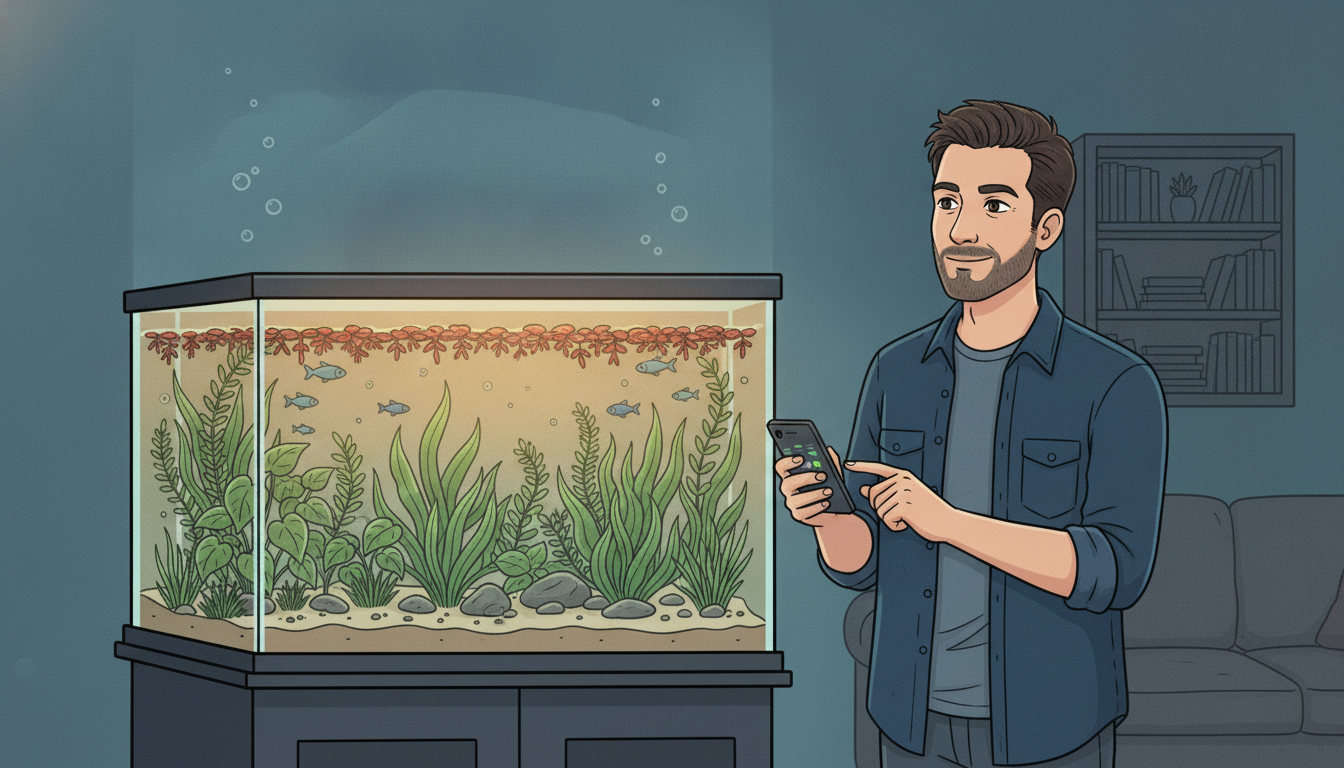
You leave for two weeks with a clean tank. You come back to green water, or a spread of black fuzzy stuff on the plant leaves, and you can’t figure out what changed. Here’s what changed: nothing. And that’s exactly the problem.
Algae is simple at its core. It’s a plant, and like any plant it needs light and food to grow. When you’re home, you unconsciously keep it in check — you notice the glass getting hazy, you trim, you scrape, you adjust. Leave for two weeks and all that quiet management stops, but the light keeps blasting away on whatever schedule you left it on. Give algae long hours of light and steady nutrients with nobody interfering, and it does what it’s built to do. It takes over.
The good news is that light is the one input you can put on full autopilot. And it’s the one that gives you the most control for the least effort.
Start with the mistake almost everyone makes: too many hours. A tank lit for ten, twelve, fourteen hours a day is a buffet with the lights left on all night. Your plants don’t need that, and the extra hours mostly feed algae. Dial the total down. A photoperiod in the six-to-eight-hour range is plenty for healthy plant growth in most low-tech tanks, and it starves algae of the surplus it was living on. Fewer hours, not more, is the counterintuitive move.
Next, the trick that actually surprises people: the siesta. Instead of one long block of light, split it into two shorter blocks with a dark gap in the middle. Something like a few hours in the morning, a few hours off, then a few hours in the evening. Plants handle this just fine — they ramp back up quickly when the light returns. Algae, oddly, doesn’t cope with the interruption nearly as well. That midday dark period acts like a little reset that keeps algae on the back foot. It’s a genuinely free tool. Same total light, arranged smarter.
Now automate all of it so it happens whether you’re home or not. This is where a decent app-controlled LED light earns its place. Modern aquarium lights let you set the whole day in advance: a slow sunrise ramp, your morning block, the siesta gap, an evening block, then a gentle fade to a dim blue night setting. You program it once, and the light runs that exact day, every day, forever — no memory required, no “did I turn it on?” Nobody has to touch it while you travel. If your light isn’t app-smart, a plain outlet timer does the core job too; you just lose the gentle ramping.
That sunrise-and-sunset ramp is a nice touch beyond looks, by the way. Lights that slam fully on and fully off are a small daily shock to the fish. A gradual fade in and out is calmer for them, and it looks a lot better on a video call, which — if you’ve read anything else I’ve written — matters to me more than I’d like to admit.
One warning about the night setting: keep the blue “moonlight” mode short or off. It looks incredible, but a blue light burning all night is just more light, and more light is more algae. Use it for an hour of ambiance in the evening if you love it, then let the tank go properly dark. Fish need real night, and darkness is a free algae control you’d be silly to skip.
Put it together and your travel lighting plan is short: total hours down to six to eight, split into two blocks with a dark siesta between, running on a timer or a smart schedule, with the night light kept brief. Set it during your pre-trip dress rehearsal, watch it flip on and off correctly for a couple of days, and then forget about it.
The last time I got back from two weeks away, the tank was as clean as when I left. Not because I got lucky. Because the light did the exact same disciplined thing every single day I was gone, and algae never got the long, lazy hours it needed to move in.
That’s the whole win here. You can’t scrape glass from an airport. But you can set a schedule that never gives the algae a reason to grow in the first place.