Power Outage Fail-Safes: Your Fish Suffocate Long Before They Get Cold
September 11, 2026
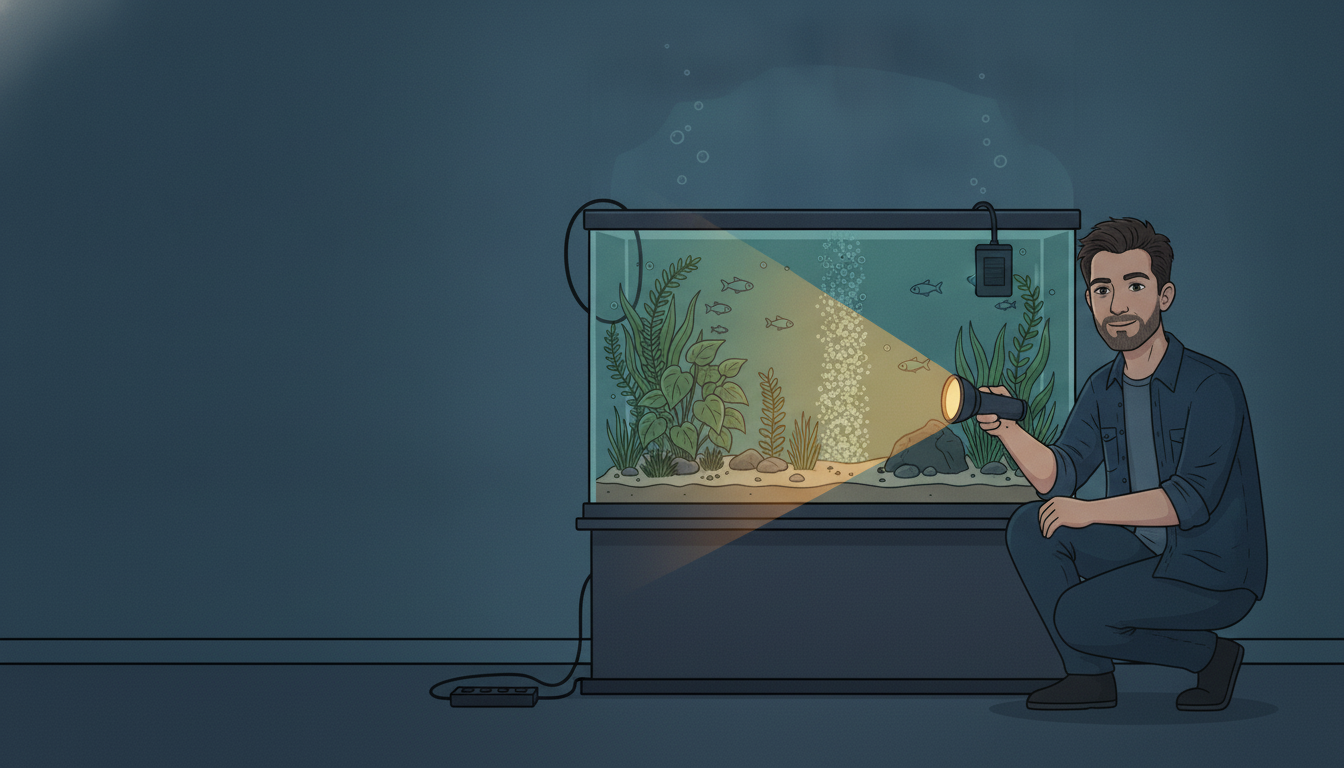
A 75-gallon tank in a heated room holds its temperature for the better part of a day.
It holds its oxygen for about two hours.
Those two numbers are the whole article, and almost every blackout plan I read online gets them backwards. People buy the generator to keep the heater running. Meanwhile the thing that’s actually about to kill their fish is free to fix and already happening.
The failure order, in the order it happens
Your tank doesn’t have one clock running during an outage. It has four, and they fire in sequence.
Oxygen, roughly one to three hours in. Almost all the oxygen entering your tank arrives at the surface, where moving water meets air. Your filter return and your air stone are what keep that surface broken up. Kill the power and the surface goes flat, gas exchange slows to a crawl, and the fish keep breathing exactly as fast as before. Warm water makes it worse, because warm water holds less dissolved oxygen to begin with. A heavily stocked tank makes it much worse.
Here’s the part that catches planted-tank people off guard, and I include myself. Plants are not helping you here. Plants only produce surplus oxygen while they’re lit — the rest of the time they respire like everything else, consuming it. In a dark house, that beautiful jungle of yours is on the wrong side of the ledger.
Watch for fish hanging at the surface and gills working hard. That’s not them being curious.
Filter bacteria, two to four hours in. The nitrifying bacteria doing your biological filtration need oxygenated water flowing past them constantly. Inside a sealed canister filter, the trapped water goes oxygen-starved fast — call it an hour or two — and the colony starts dying in the dark. Sponge filters and hang-on-backs fare much better, because their media sits in or near open air and stays damp and breathing for far longer.
Ammonia, six hours and beyond. Fish keep producing waste. The bacteria that normally convert it are dead or dying. The maths from there is unpleasant and straightforward.
Temperature, a day or more out. Water is a heat reservoir, and a big tank in a normally heated house drifts down slowly — a degree or two over a night, not ten. It matters eventually. It is almost never what gets you first.
The mistake that kills fish after the power comes back
This one deserves its own section, because it catches good aquarists and it feels like the opposite of a mistake.
Power’s been out six hours. It comes back on. You’re relieved. You flip the canister filter back on.
Don’t.
That canister has been a sealed container of still, oxygen-free water for six hours. The good bacteria in there suffocated, and what’s growing in their place is the kind that thrives without oxygen and produces hydrogen sulphide — the rotten-egg gas. Switching the filter on pumps all of that, plus a slug of ammonia-rich sludge, directly into your display tank in one push. Fish that survived the entire blackout die an hour after the lights come back, and the owner never connects the two events.
The rule I use: if a canister has been off more than about two hours, don’t restart it into the tank. Open it, tip the water out, rinse the media in a bucket of tank water until it stops smelling, then put it back together and start it. Takes fifteen minutes. Saves the tank.
Hang-on-backs and sponge filters don’t have this problem in any serious way, since they were never sealed. Another quiet point in favour of the boring filter.
How long do outages actually last?
Worth knowing before you spend anything, because the honest answer changes what you buy.
The U.S. Energy Information Administration publishes this every year. For 2024, the average customer lost power about once, for a total of roughly two hours, once you exclude major events.
That word “excluding” is doing enormous work. Counting the big storms — 2024 had several bad ones — the average jumps to around eleven hours, and about eighty percent of all outage hours that year came from those major events alone.
So there are really two different problems wearing the same coat:
- The ordinary outage. Roughly two hours, once a year, no warning. Cheap to solve completely.
- The storm. Days, not hours. Rare, regional, and it laughs at a pair of D batteries.
Most people only need the first one solved. If you’re on the Gulf coast, or anywhere ice storms take lines down for a week, you need to plan for the second — and you know who you are.
The layers, cheapest first
Layer zero costs nothing. Understock the tank. Run a sponge filter somewhere in the system even if it’s not your main filtration, because it’s the one piece of gear that keeps its bacteria alive through almost anything. And when the power does go out, stop feeding — fish are fine unfed for days, and every flake you add is more waste and more oxygen burned at exactly the wrong moment.
Layer one is the auto-start air pump, and it is the best money in this entire hobby. Not “a battery air pump.” An auto-start one. The distinction is everything: a manual pump sitting in a drawer requires you to be home, awake, and aware. The auto-start unit plugs into the wall purely to sense voltage, sits silent while the power is fine, and switches itself on the instant it isn’t. It buys you the single thing that’s actually running out — surface agitation, and with it oxygen — for somewhere between twenty and forty hours.
If you buy one thing after reading this, buy that.
Layer two is a small UPS carrying the gear you already own. An air pump draws a couple of watts. A sponge filter’s pump draws about the same. A modest office UPS runs either of them for many hours, and it has the nice property of keeping your existing setup running rather than swapping in an emergency one.
Two things the box won’t tell you. Small inverters waste a meaningful slice of their battery just being switched on, so measure your actual runtime with a stopwatch on a Saturday instead of dividing watt-hours by watts and believing the answer. And keep the heater off it, always. A heater is a hundred watts and up; it will drain a UPS in minutes and take the air pump down with it. In a blackout, oxygen outranks warmth by a wide margin.
Layer three is a portable power station, and it’s for storm country only. A LiFePO4 battery box with real sockets on the front will run a filter, a pump and a heater for a long stretch. It costs real money and it’s genuinely overkill for a two-hour outage. If you lose power for days at a time, it’s also the only thing on this list that actually solves your problem.
And past that? A standby generator is a wonderful thing to own for many reasons. Your fish are not one of them.
The plan, sized to your actual risk
If you’re home most of the time and your power blips for an hour or two a year, an auto-start air pump is a complete solution. Genuinely complete. Add the “don’t restart the canister” rule to your memory and you’re done.
If you travel — and if you’re reading this site, you travel — the auto-start feature stops being a convenience and becomes the entire product. Nobody is home to flip a switch. Nothing on your backup shelf helps if it needs a human hand.
And there’s one honest gap worth naming. Every layer here is defence. None of them is detection. A pump running on batteries in an empty house is doing its job perfectly and telling nobody, and battery pumps do have a runtime, and outages do sometimes outlast them. If you’re away for weeks at a time, something that can actually reach your phone when the power drops is the other half of this — the cutting-in is what saves the tank, the telling is what saves the trip.
Test it before you need it. Pull the plug on a Saturday afternoon, stand there with a coffee, and watch what your tank actually does for twenty minutes. Every fail-safe I’ve added to my own setup needed one round of adjustment before I trusted it, and a Saturday is a much better time to discover that than a Tuesday in February.