Alternanthera Reineckii Without CO2: A Low-Tech Grow Guide
August 22, 2026
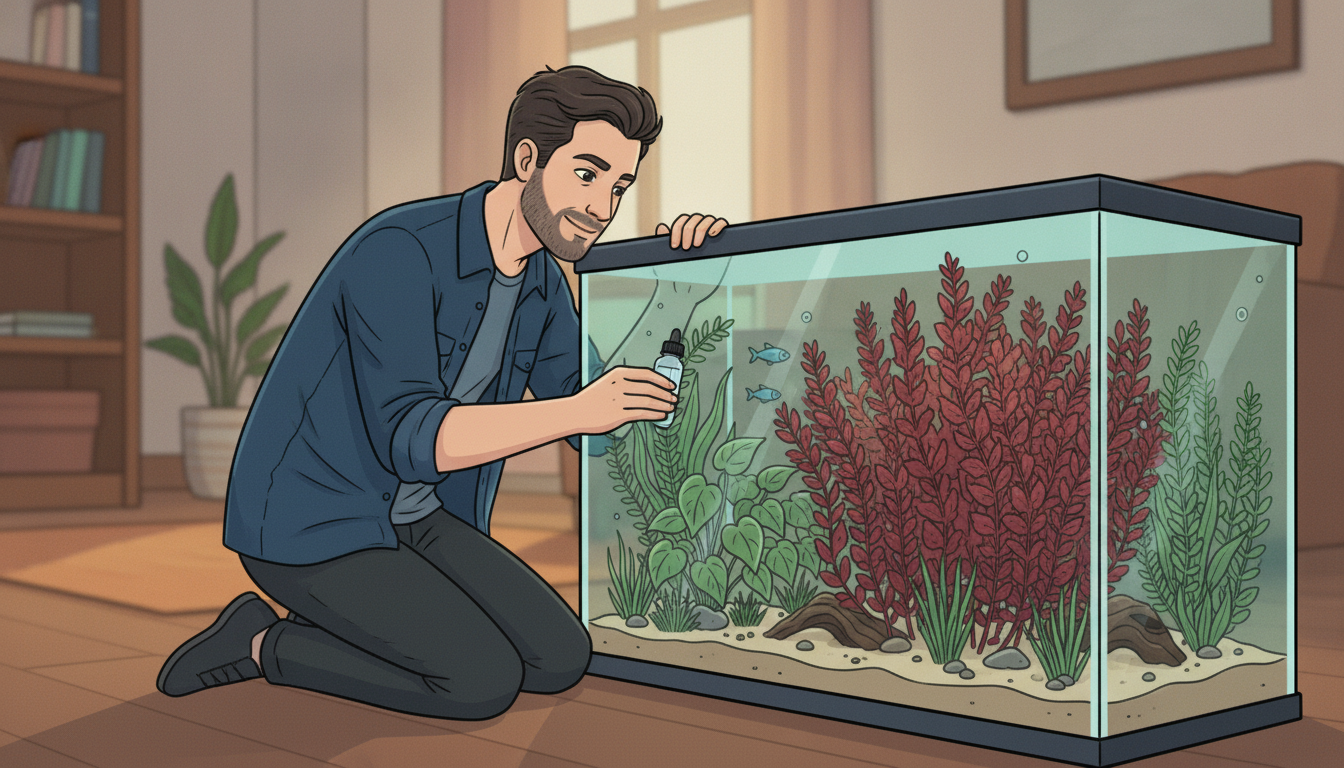
Ask around about growing red plants and you’ll hear the same wall go up fast: “you need CO2.” Pressurized tank, regulator, diffuser, drop checker, the whole rig. It’s presented like a law of nature.
It isn’t, and Alternanthera reineckii — AR, if you’ve spent any time in plant forums — is the plant most people use to find that out. It’s widely sold, it’s genuinely red rather than a green plant pretending, and it’s forgiving enough to survive a tank nobody is standing over. So this post is the grow guide for that one plant: substrate, dosing, light, trimming, in the order that actually matters.
One thing before we start, because I’ve written twice about reds and I don’t want you reading the wrong page. If you’re still choosing which red plant to buy, go read the species list — which reds hold colour without gas and which never will. That post picks the plant. This one assumes you’ve already bought AR and want it to look like the photo.
What you’re actually signing up for
AR is a genetic red. It doesn’t need to be stressed into colour the way a Rotala does — it packs red pigment as a matter of course, which is exactly why it’s the standard answer to “can I do red without gas.”
Here’s the honest ceiling, and I’ll let the people selling it say it. Aquarium Plants Factory’s own care notes for AR ‘Mini’ list CO₂ as “recommended, not essential,” then add: “It will grow without, just slower and greener.” That’s a vendor arguing against their own upsell, and it matches what’s in my tank. Mine is a warm reddish-bronze. It is not the electric magenta on the tag.
So calibrate now. Low-tech AR is red. It’s a quieter red, and it grows at maybe half the pace. If you were expecting the contest-tank crimson, the gap is real and no amount of dosing closes it.
Substrate first — it’s the only decision you make once
Everything else on this list is a weekly habit you can get wrong and fix. The substrate is the one you do on day one and live with for years, so start there.
AR feeds both ways. Aquarium Plants Factory lists it as a “root and water column feeder,” and that’s the useful detail — it isn’t a crypt that lives entirely off its roots, and it isn’t a floating stem that ignores the substrate. Plant it in plain inert gravel and you’ve switched off half its supply.
What volcanic soils like Fluval’s actually do is a bit different from “fertilizer in the ground,” and the distinction is worth having. Fluval’s own product page describes a “proprietary mix of powerful nutrients, minerals and trace elements,” collected from the foothills of Mount Aso. The granules are porous and non-compacting, which is the part that matters most for a stem plant: roots spread through it instead of fighting it.
Grain size is the bit nobody checks, and Fluval publishes it. Plain Stratum runs 3-5 mm and the company specs it for “plants with larger root systems” — swords, crypts, the big rooted stuff. Bio-Stratum is the 1-3 mm powder format, specced for “fine and delicate root systems,” and it’s seeded with dormant bacteria that activate in water. AR ‘Mini’ has fine roots. So the powder is the right format here, and if you want the coarser 3-5 mm for a tank built around big root networks instead, that’s plain Stratum — I couldn’t find a clean current listing for the standalone bag, so buy that one at a local shop rather than guessing at a marketplace box.
One warning that comes from Fluval and not from me: both formats soften water and reduce carbonate hardness, and Fluval’s own page recommends regular KH testing. On a tank you leave alone, that’s not a footnote. KH is your pH buffer, and a buffer quietly dropping while you’re in another time zone is precisely the kind of slow failure this whole site exists to design out. Test it a few weeks after setup. If it’s falling, that’s a water-change schedule question, and I’ve covered the mechanics of making those easy enough that you actually do them.
Then feed the water column — and check the label
This is where I have to correct my own post, because the earlier version of this page recommended Seachem Flourish and described it as a complete fertilizer carrying the full set of nutrients. That’s wrong, and Seachem says so themselves. Their Flourish page states plainly that it “does not contain significant levels of nitrogen or phosphorus,” and that it’s “designed to be used in conjunction with other macro and micro-nutrient supplements.” Flourish is a trace supplement. It’s a perfectly good trace supplement. It is not the one bottle you dose if you’re only dosing one bottle.
For that you want a genuine all-in-one, meaning something with nitrogen, phosphorus and potassium in it alongside the traces. Aquarium Co-Op’s Easy Green is the one I keep on the shelf, and the reason is less about the brand than about the fact that it prints its guaranteed analysis: NPK 2.66-0.46-9.21, water-soluble iron 0.13%, plus magnesium, manganese, boron, zinc and molybdenum. You can read that and know what you bought. They also publish the math — 1 mL in 10 gallons adds roughly 3 ppm of nitrate — which means on a 40-gallon tank, 4 mL gets you about 3 ppm, and you can reason about your dose instead of counting capfuls and hoping.
Dose it weekly. It takes about ten seconds.
And while we’re here: iron will not make your plant red. The iron myth is everywhere, including on the care sheet of the vendor I just linked, which tells you “iron is what deepens the red.” It doesn’t. Iron is a cofactor in chlorophyll synthesis — the green pigment. A plant short of iron goes pale and yellowish, and giving it iron returns it to healthy green. Keep a trace level around so nothing goes deficient, and stop. Dosing iron past that adds no colour and is a reliable way to feed an algae bloom you come home to. AR is red because of its genetics, and it was going to be red anyway.
Light: enough, consistently — and it’s the last dial you touch
Now the dial everyone reaches for first.
Light is doing something real for AR, and it isn’t colour. Aquarium Plants Factory puts it well: “Strong light is what keeps it compact rather than leggy.” That’s the actual trade. Under moderate light AR stretches — longer gaps between leaf nodes, a taller thinner plant reaching for the surface. Under strong light it stays short and dense.
Which sounds like an argument for cranking the fixture, and on a tank you’re watching daily, maybe it is. On this one, no. Plants under hard light need carbon to keep pace with it. Without injected CO₂ there’s a limit to how much they can use, and the surplus light energy doesn’t just evaporate — algae are delighted to take it. You crank the fixture to chase a compact plant, and two weeks later you’re standing in your kitchen with a suitcase looking at a green wall. I’ve gone through the photoperiod half of this in detail; the short version is that long hours are the usual culprit, but intensity without carbon arrives at the same place.
So: a decent planted light, medium intensity, run on a timer for a normal photoperiod of around seven or eight hours. Not blinding. Not fourteen hours. Then accept that your AR will be a little leggier than a high-light tank’s, and fix that with scissors instead of watts — which is the next section, and it’s free.
Trimming is the whole trick
If you do one hands-on thing for this plant, do this.
Cut the tops. AR responds to being topped by branching out below the cut, so a single leggy stalk becomes two, then four. That’s how you get the bushy clump instead of a row of bare stems with leaves on top. And the cuttings replant — push the trimmed tops into the substrate beside the parent and they root. A group of three stems becomes a real stand of red over a few months without you buying anything else.
Trim every few weeks when it’s growing well. It’s the one piece of maintenance on this page I’d call non-optional, and it’s also the only one that gives you free plants.
The other half of trimming is patience, which is harder. Low-tech growth is slow. A new AR will sulk for a few weeks while it settles its roots, and new stems may come in smaller and paler than the ones on the plant you bought — that’s it adapting from however it was grown to your water and your light. Most low-tech “failures” I hear about are really week-two impatience. Give it a month before you decide.
So what does CO2 actually buy?
Speed and intensity. That’s the honest answer, and gatekeeping helps nobody.
With pressurized gas AR grows faster, fills in denser, and can reach a deeper, more electric red than a low-tech tank usually hits. If you’re building a competition-grade crimson carpet, that’s the tool, and I won’t pretend otherwise.
But “deep show-red, fast” is a different goal from “a healthy red plant I don’t have to babysit.” The second one is very achievable without gas, and it’s the one most of us actually want. My AR looks genuinely great as a splash of colour against all the green. Nobody on a video call has ever squinted at it and said “hmm, insufficient CO₂.” They say it looks alive.
The order, since the order is the point
- Substrate, chosen once, grain size matched to the plant — then test your KH a few weeks in.
- A real all-in-one, weekly, with a label you’ve actually read.
- Medium light on a timer, consistent, around seven or eight hours.
- Scissors, every few weeks, replanting the tops.
- A month of leaving it alone before you judge any of the above.
Nothing on that list is a CO₂ cylinder running in my house while I’m three time zones away. For a tank that has to look good and run itself while I’m gone, that’s a trade I’ll take every time.