A Bigger Tank Is Less Work: What Size Aquarium a Beginner Should Actually Buy
September 22, 2026
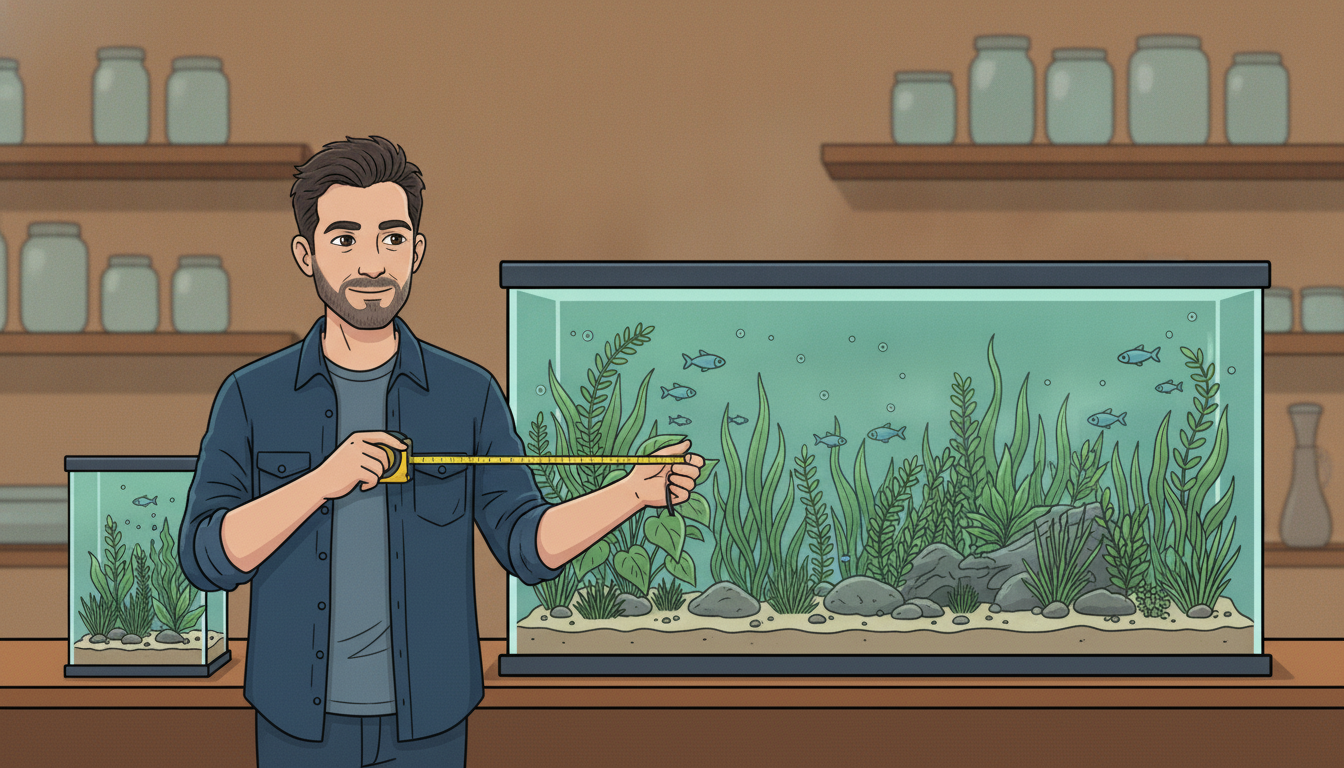
Start small, they told me. It’s cheaper, and it’s easier.
Half of that is true.
A ten-gallon tank is cheaper. It is not easier. It’s the hardest tank in the store to keep alive, and the reason is math that nobody ever does in front of a beginner standing in the aisle.
So let’s do it. This is the one decision you make before you spend a dollar on gear, and it buys you more margin than every gadget I write about on this site put together.
What volume actually buys you
One thing: dilution.
Think about what actually goes wrong in a tank. A fish dies behind a piece of wood. Food doesn’t get eaten and rots in the substrate. A filter stalls while you’re at work. Not one of those events cares how big your tank is — it’s the same fish, the same pinch of food, the same stopped filter.
What changes is how much water the mess gets spread through.
That’s the whole mechanism, and it’s almost embarrassingly simple: the mess is fixed, the water isn’t. Double the water and you halve the number that shows up on your test card.
Now let’s put real numbers on that, because “it’s more stable” is what everyone says and nobody proves.
The ten-gallon myth, with the numbers
A fish dies behind the driftwood and you don’t spot it for two days.
Say that’s enough to put 1.0 ppm of total ammonia on your test card in a 10-gallon tank. Pick a different starting number if you like — the ratios below don’t move.
Same fish, same two days. A 40-gallon breeder holds four times the water, so it reads 0.25 ppm. A 75 holds seven and a half times as much: 0.13 ppm.
Here’s why that gap matters more than it looks on paper.
Your test kit measures total ammonia. But ammonia sits in water in two different forms, and only one of them is the dangerous one. The University of Florida’s extension service says it plainly: the un-ionized form, NH₃, is “approximately 100 times more toxic to fish than the ionized (NH₄⁺) form.”
How much of your total is the bad form depends on pH and temperature. At 77 °F it works out roughly like this:
- pH 7.0 → about 0.6% of the total is the toxic form
- pH 7.5 → about 1.8%
- pH 8.0 → about 5.4%
That’s the standard equilibrium calculation — ammonia’s pKa sits right around 9.25 at that temperature — and it matches the table UF/IFAS publishes from Emerson et al., 1975.
So run our dead fish through an ordinary planted community tank at pH 8.0 and 77 °F:
| Tank | Total ammonia on the card | Actual toxic NH₃ |
|---|---|---|
| 10 gallon | 1.0 ppm | 0.054 mg/L |
| 40 breeder | 0.25 ppm | 0.013 mg/L |
| 75 gallon | 0.13 ppm | 0.007 mg/L |
And here’s the line that decides it, from the same UF/IFAS publication: “Anytime the UIA is higher than 0.05 mg/L, damage to fish tissues can occur.”
The ten-gallon is over that line. The forty is at about a quarter of it. Same dead fish, same two days of nobody noticing, and one tank is doing gill damage while the other is having a completely normal Tuesday.
Nothing about the small tank failed. It just had nowhere to put the mess.
One honest adjustment before you go quoting those numbers at somebody: the number on the box is the volume to the rim. Substrate, rock and wood eat into it, so a “40” in service is usually holding somewhere in the low thirties. That trims the advantage a bit. It does not come close to erasing it.
Bigger swings temperature slower too — but not by as much as you’d think
This is where most people making my argument overclaim, so let me be careful.
It’s tempting to say four times the water means four times the temperature stability. It doesn’t, and the reason is that a bigger tank also has more glass for heat to leave through.
Run the numbers on standard tank dimensions and you get the glass area each gallon has to share:
| Tank | Glass area per gallon |
|---|---|
| 10 gallon (20¼ × 10½ × 12½) | about 120 in² |
| 40 breeder (36 × 18¼ × 17) | about 79 in² |
| 75 gallon (48½ × 18½ × 21) | about 62 in² |
So the ten-gallon carries roughly one and a half times the heat-losing surface per gallon that a 40 breeder does, and about twice what a 75 does. That’s your real temperature margin: the small tank cools off around one and a half times faster, not four times faster.
Treat that as a ballpark rather than a spec — the open water surface, your lid, and how much air moves past the tank all matter too. But the shape of it is right, and it’s worth knowing that volume buys you the full ratio on chemistry and only part of it on heat.
Which is still a real win. A room that drops five degrees overnight drags a ten-gallon down with it much faster than it drags a forty. That’s exactly the kind of slow, boring margin I want in a tank nobody’s standing next to. What it is not is a reason to think about your heater differently — that’s its own set of decisions, and I’ve covered the two that matter in heater controllers and monitoring for a heater failure.
The three places bigger genuinely is more work
I’m not going to pretend this is free.
It’s heavy, and it’s heavy in a small spot. Water runs about 8.34 pounds a gallon before you add glass and substrate. Aqueon lists a filled 40 breeder at 458 lb and a filled 75 at 785 lb. Now divide by the footprint: the 40 stands on 4.6 square feet, which works out to roughly 100 lb per square foot, and the 75 lands nearer 126. For reference, residential building code sets the minimum design live load for ordinary living space at 40 lb per square foot (IRC Table R301.5; bedrooms are 30).
Don’t panic at that comparison — the code figure is a uniform load spread across a whole floor, and your tank’s weight gets carried by several joists at once through the subfloor. But it is the reason that, once you’re past about 55 gallons on a wood floor, you want to know which way your joists run, set the tank across them rather than along a single one, and keep it near a load-bearing wall instead of out in the middle of a span. I’m a systems engineer, not a structural one — if your floor is old, or bouncy, or upstairs, that’s a question for somebody who can actually look at it. A basement slab makes the whole issue disappear.
The water changes get real. A 25% change on a ten-gallon is two and a half gallons. On a 75 it’s about nineteen — call it 155 pounds of water, out and then back in. That is the single cost of a big tank most likely to make you skip maintenance, which defeats the entire point of buying margin in the first place. It’s solvable, and it’s solved with a hose rather than a bucket: I went through the options in the easiest way to do a water change.
The whole kit scales, not just the tank. A bigger tank means a bigger filter, a stand actually rated for the load, a longer light, a lid that spans further, more substrate, more plants, more dechlorinator per change. The tank is often the cheapest line on the receipt. Budget for the system, not the glass box.
The size I’d buy if I could only own one
A 40-gallon breeder.
I run a 75 and I’m happy with it, but if I were starting over with one tank and a normal room, the 40 breeder is the one I’d walk out with. It gives you four times the chemistry margin of a ten for about three times the floor space. It’s short — under 17 inches tall — so you can reach the bottom without standing on something, and light reaches the substrate without a fight. It sits on a standard 36-inch stand. And a 25% water change is ten gallons, which is small enough that you’ll actually keep doing it.
If a 40 genuinely won’t fit the room or the budget, a 20 long is the smallest tank I’d send anyone home with. Below that you’re not buying a starter tank, you’re buying a tank that punishes a beginner for beginner mistakes.
Where volume stops being the answer
Volume is the cheapest margin you can buy, but it isn’t the only one, and it doesn’t cover for the other thing that decides whether a tank forgives you: how much you put in it.
A packed 75 and a lightly-stocked 40 are not the same tank, and the 40 will be the calmer one. Tank size sets your ceiling. Stocking and filtration decide how close to that ceiling you choose to live. I wrote about that half of it separately, in the biological buffer — this post is about how big to buy, that one is about what to put inside it. You want both.
But you make this decision first, and you make it once. Get it right and every other choice on this site gets easier.
Buy the bigger tank. Put fewer fish in it. Then go on holiday.