How to Cycle a Fish Tank: Build More Bacteria Than You Need
October 20, 2026
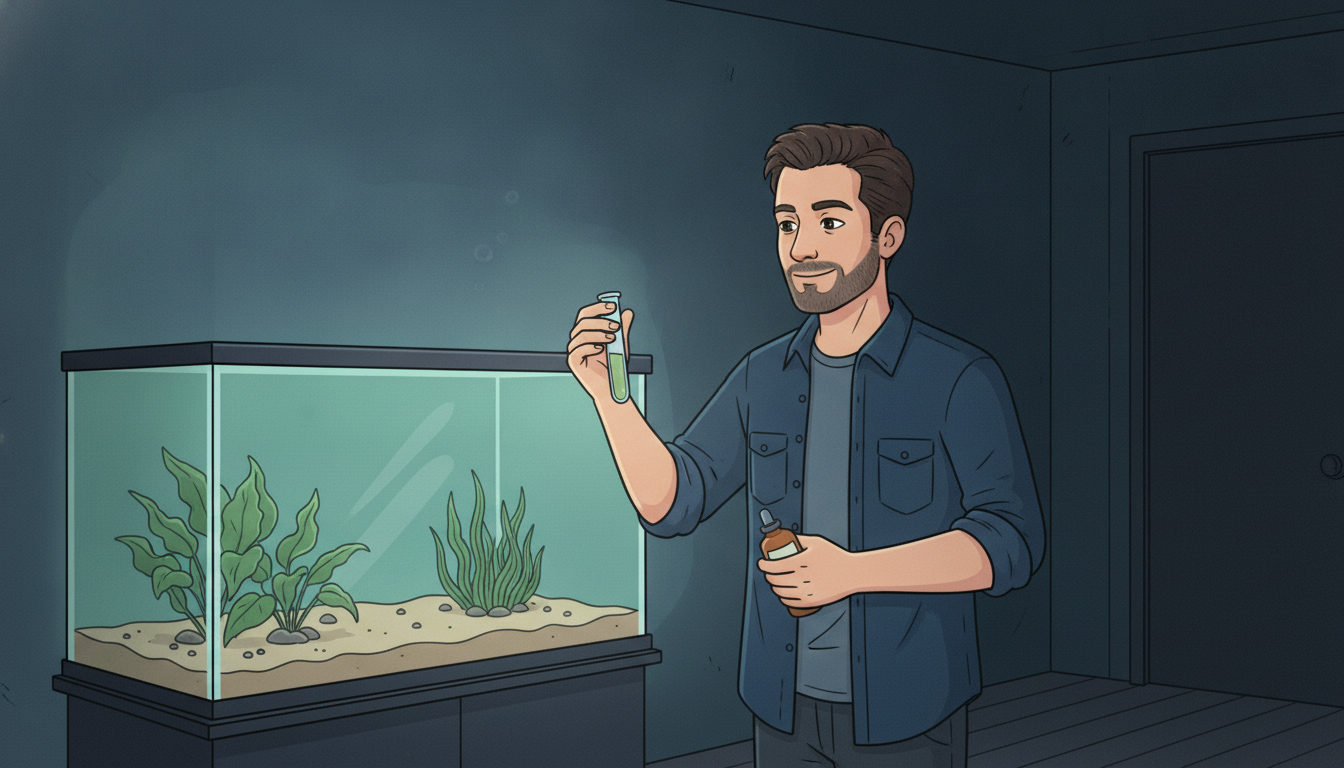
The point of your first thirty days is not to get fish into the water. It is to build more bacteria than those fish will ever need — because surplus is the only thing in this hobby that forgives you later.
Every cycling guide I have read optimises for the same thing: speed. How fast can you add fish. Seven days with a bottle. Three weeks the slow way. “Instant cycle” on the box.
That is a reasonable goal if your plan is to stand over the tank every day. It is the wrong goal for the kind of tank this site is about — the one that has to hold steady through a missed water change, an overfeed by an eight-year-old who was “helping,” and two weeks while you are somewhere else.
What a cycle actually is
Fish produce ammonia. Ammonia is poisonous to fish at very low concentrations. In an established tank you never see it, and the reason is that two groups of bacteria have moved in and are eating it as fast as it appears.
The first group converts ammonia to nitrite. Nitrite is also poisonous. The second group converts nitrite to nitrate, which is far less harmful and which you remove with water changes or feed to plants. That hand-off is the nitrogen cycle, and “cycling a tank” just means growing those two colonies — on your filter media, in the substrate, across every surface in the box — before anything is living in there that they could kill.
That is the whole lecture. The colonies are not something you buy or install. They are something you grow, and like anything you grow, the size they reach depends on how much you feed them.
Why “fast” is the wrong target
Here is the part the speed-focused guides skip.
Those bacterial colonies size themselves to their food supply. Feed the tank a little ammonia and you get a small colony. Feed it a lot and you get a bigger one. The bacteria are not holding capacity in reserve out of politeness — they grow to match what arrives, and they stop when it runs out.
So a tank cycled on the minimum, stocked immediately to the maximum, is running with no margin at all. It works. It works right up until the day something changes — a fish dies behind the driftwood, the feeder dumps a double portion, you are away and nobody notices — and then the colony has to grow to meet the new load. Growing takes days. The ammonia spike takes hours.
That gap is where tanks crash. Not from bad gear. From no margin.
Feed the cycle harder than your fish will
Fishless cycling solves this cleanly, and it is the only method I will recommend for a tank you intend to leave alone.
You set the tank up fully — filter running, heater on, substrate and plants in, no livestock — and you add ammonia yourself. Bottled ammonium chloride sold for the purpose is the clean way to do it. A raw shrimp left to rot in the corner also works and is considerably worse to live with.
Dose it to about 2 ppm, test, and keep dosing it back to 2 ppm every time it drops. Most stocking plans for a sensibly-stocked tank will not produce anything close to 2 ppm a day, which is the point — you are deliberately training the colony against a load heavier than the one it will actually see.
There is a ceiling, though, and this is where “harder” stops being better. Push ammonia much past about 5 ppm and you start inhibiting the very bacteria you are trying to grow; the same is true if nitrite is allowed to climb and sit up around 15 ppm or higher. People who dose “extra to be safe” routinely stall their own cycle this way and then spend three weeks wondering why nothing is happening. If nitrite goes off the top of your test chart and stays there for days, do a large water change and carry on dosing at 2 ppm. You are not starting over. You are getting out of your own way.
The numbers you are waiting for, and the one you can ignore
You are waiting for exactly one result, and you want to see it twice.
Dose ammonia to 2 ppm. Twenty-four hours later, ammonia reads 0 and nitrite reads 0. That is a cycled tank. Both of them, to zero, within a day. Not “nearly zero.” Not “zero ammonia but a bit of nitrite” — that one means your first colony is up and the second one is still catching up, which is the normal order and is very easy to mistake for finished.
The number you can ignore during the cycle is nitrate. It will climb, and watching it climb is mildly satisfying because it proves the chain is working end to end, but it is not the finish line and chasing it down with water changes while you are still cycling just slows you up. Deal with nitrate on day 30 with one big change, right before the fish arrive.
One thing that genuinely can stall you: if your pH drops below roughly 6.5, nitrification slows down hard, and a long fishless cycle will drag pH down on its own as it runs. If your numbers freeze for a week with no other explanation, test pH before you change anything else. On Winnipeg city water this rarely bites — the City’s published figures put us around 80 mg/L hardness with alkalinity in the same neighbourhood and pH just under 8, which is enough buffer to ride out a long cycle. On well water, softened water, or anything RO-heavy, a stalled pH is the first thing I would check.
The extra two weeks
Here is the part nobody does, and it is the entire argument of this post.
When you hit that first clean 24-hour conversion, you are not finished. You are qualified. Keep dosing to 2 ppm daily for another two weeks and keep testing.
What that buys you, specifically:
- A second and third confirmation. One clean result can be a mis-read, a reagent that was shaken badly, or a colony that clears 2 ppm today and not tomorrow. Three clean results in a row is a cycle.
- Time for the slower half to finish. The nitrite-eaters grow more slowly than the ammonia-eaters. At first conversion they are typically the junior partner, barely keeping up. Two more weeks at full load is what moves them from “just coping” to “has room.”
- Biofilm, not just bacteria. A colony fed heavily for a month builds out physically — more surface colonised, deeper in the media, further into the substrate and the hardscape. That built-out surface is what lets the tank re-staff itself quickly after a knock, which matters more than the peak headcount.
And an honest caveat, because you will read the opposite elsewhere: you do not get to keep a four-times colony forever. Stop feeding it 2 ppm a day and the population drifts down toward whatever your fish actually produce. Bacteria do not hold a reserve for you.
What you keep is the thing that matters. The die-back takes days to weeks, not hours — so across the window where trouble actually happens, you are still running surplus. And the colonised surface area stays colonised. That is your margin.
Stock under what the tank can carry
On day 30, do a large water change to clear the nitrate, and then do the thing that makes the whole exercise pay: stock under capacity, and stock slowly.
Not “to the limit, carefully.” Under it. If your tank and filter could carry a dozen fish, put in six, wait a month, and then decide whether you actually want the other six. Most people find they do not. A lightly-stocked tank is quieter, clearer, and visibly less work, and it is the single biggest lever on whether the tank survives you being absent.
This is the same argument I have made from the other direction in the biological buffer — understocked and over-filtered is a design choice, not a compromise. The cycle is where that choice gets made, before there is a single fish in the box to complicate it.
If you are in a hurry anyway
Sometimes the fish are already on their way. Two things genuinely shorten this, and one of them does not.
Seeded media works. A used sponge, a handful of ceramic media or a cup of gravel from an established, healthy tank brings a live colony with it and can cut weeks off the schedule. Ask at a local shop or a club — most keepers will hand you a squeezed-out sponge for nothing. Keep it wet on the way home and get it into the filter the same day.
Bottled bacteria is a maybe, and the maybe depends on the bottle. A few products contain the organisms that actually do this job in a freshwater tank; most contain something else that dies off and makes a lovely bacterial bloom while your ammonia sits there. I went through how to tell them apart, and the four situations where a real bottle earns its money, in the bottled-bacteria post.
Fish-in cycling does not shorten anything. It just moves the ammonia exposure onto something with gills. If circumstances have already put you there, the tank still takes the same month to cycle — you are simply doing daily water changes through all of it, and the fish are paying for the schedule.
What this actually costs you
Two extra weeks. That is the entire price.
Two weeks of a lit box of water with no fish in it, a bottle of ammonia, and a test kit — against a tank that absorbs a missed week, a heavy-handed feeding, and a holiday without you standing over it.
I have set up tanks both ways. The one I cycled properly is the one I have never had to think about from an airport.
Still deciding on the tank itself? Bigger is genuinely less work, and the reason is the same one as this post: volume is margin, and margin is what you are buying.