Do Mystery Snails Escape? Yes — Here's Where Yours Went
August 28, 2026
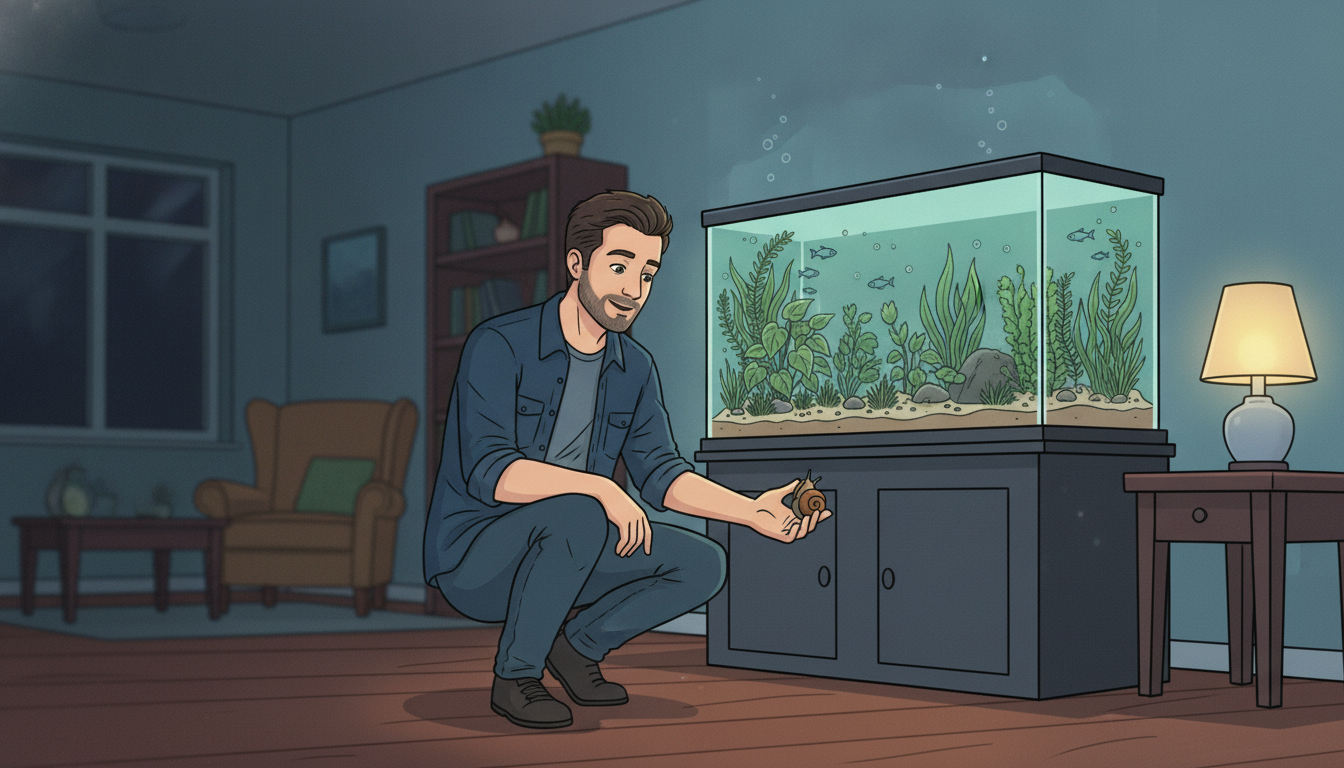
Yes. Mystery snails climb out of tanks, and they do it more often than most people expect. They breathe air through a siphon, they graze right along the waterline, and a gap at the rim — the notch cut for a filter or a heater cord — is a door as far as they’re concerned. A snail on the floor isn’t a freak accident. It’s a snail that found the opening.
But here’s the part that matters more, because it’s the thing almost nobody gets told: if your snail has gone missing, it most likely never left the tank. Escapees usually turn up fast, on the floor or the wall, within a few feet of the stand. A snail that has genuinely vanished is usually buried, wedged, floating somewhere you aren’t looking, or dead and already being cleaned up.
So let’s do the search first, then the reasons, then the fix.
Missing snail? Check these five places before you panic
Mystery snails stay around two inches across. A tank has more hiding spots than that.
- Under the substrate. They push down into sand and fine gravel to rest, to get out of bright light, or to chase food that sank. Look for a shell-sized dimple and sweep a finger through the top inch. This is the one people skip, and it’s the most common answer.
- Wedged in the hardscape. Behind rock, under driftwood, inside a cave or an ornament. They can get into a space and then take their time about getting out of it.
- Behind or inside the filter. Mystery snails hold air in their lung to float and let it out to sink. A floating snail goes wherever the flow takes it, and the flow takes it to the far corner or behind the filter box. Check the intake too.
- Up in the floating plants. Same floating trick, different landing spot. A golden snail sitting in a mat of frogbit or duckweed is genuinely hard to spot from the front of the tank.
- Gone, and tidied away. Mystery snails live about one to two years. They’re also scavengers that eat dead animals, so when one dies the tank clears it quickly and the empty shell settles into the substrate where you’ll never notice it.
Give the search a couple of days before you conclude anything. These snails sleep hard — it’s normal for one to go still for a stretch and then be back to grazing like nothing happened.
One thing to rule out while you’re looking: if what you keep turning up is a crowd of tiny snails you never bought, that’s a separate animal — pond or bladder snails that hitchhiked in on a plant. Worth knowing before you reach for a treatment, because a bloom of those is a reading on your feeding, not an infestation, and the copper that kills them will kill the mystery snail you’re hunting for.
Is the snail even dead?
If you have found it, out of the water and shut tight, start here. It saves lives.
I found my first escapee behind the stand — dry, shell sealed up tight, playing dead so convincingly I nearly threw it out. My son Leo found the next one on the wall, three feet up from the tank, going for a hike.
A mystery snail that’s been out of the tank can look completely gone — sealed up, no movement, light as a dry shell. It often isn’t. These snails have both gills and a lung, so a few hours in the open won’t always kill one.
Pick it up. If the trapdoor — that’s the hard “lid” on its foot, the operculum — is sealed shut and pulls tight when you nudge it, there’s a good chance it’s alive. The reliable test is your nose: a dead snail gives off a strong, unmistakable stench, and a live one doesn’t. No smell means float it in a shallow dish of tank water and give it an hour. Plenty of “dead” escapees wake up and get back to work.
Give one a real chance before you write it off.
Why they climb out in the first place
Three reasons cover nearly all of it, and the first one is the one worth acting on.
The water is telling them to leave
This is the big one, and it’s why I always check the tank before I blame the snail.
When water quality drops, snails head for the surface and then past it. Ammonia or nitrite creeping up, oxygen running low on a hot night, a pH swing — any of these can send them climbing. A snail on the glass at the waterline is common and fine. A snail on your carpet is a smoke alarm.
So before anything else, test the water. Ammonia and nitrite should read zero. If either one is up, do a water change and find the cause — an overstocked tank, a filter that quit, a dead fish tucked behind a rock. Fix the water, and a lot of “escape artists” quietly settle down.
She’s looking for a place to lay eggs
Here’s the one that surprises people. Female mystery snails lay their eggs above the waterline — a pink, cocoon-like clutch stuck to the glass or the underside of the lid, up in the air where it stays dry.
That means a female will deliberately climb out of the water to find a laying spot. It’s not distress. It’s biology. If your snail keeps cruising the top rim and you’ve got a clutch forming up there, you’ve solved your own mystery. She’s not unhappy — she’s house-hunting.
The catch: if there’s no lid, “up top” becomes “over the edge.”
They just wander
Some snails are explorers, plain and simple. Well-fed, happy, water perfect — and one still decides the whole world needs surveying. They graze along the surface film, reach the rim, feel around for what’s next, and if there’s an opening, out they go.
You won’t train this out of them. What you can do is make sure the edge of your tank is a dead end, not a doorway.
The fix: turn your lid into a real barrier
Once the water’s right, the rest is just closing gaps. A snail can squeeze through a shockingly small one.
- Leave an air gap, then cap it. Keep your water level an inch or two below the rim so snails (and their egg clutches) have breathing space inside the tank — then cover the top so that space is all they get. A fitted glass canopy is the cleanest option.
- Hunt the cord gaps. The escapes almost always happen where the lid doesn’t fully seal — the cutout for the filter, the heater cord, the airline. Those little notches are the exit. Block them.
- Make a cheap gap-cover. Plastic mesh (the kind sold for needlepoint), a strip of filter sponge wedged into the cutout, or a square of eggcrate — any of these seals a cord gap for a couple of dollars. Cut to fit, press in, done.
- Mind the background. Snails climb heater cords and airline tubing like ladders straight to the gaps. Tuck cords tight and keep equipment away from the open corners if you can.
None of this is high-tech. That’s the point. A tank that runs itself while you travel is really just a tank with no open doors — it’s one of the things I check before every trip, right alongside the rest of the fourteen-day test — and a snail on the floor is the cheapest early warning you’ll ever get that a door came open.
The real takeaway
If your snail is missing, look in the tank first. Substrate, hardscape, filter, floating plants. Most of the time it’s in there.
If your snail is out, it’s data. Check the water before anything else — usually the snail is trying to tell you something about your parameters. Then seal the cord gaps so your happy wanderers can’t turn a good day into a dried-out one.
Do both, and the only place you’ll find your snails is exactly where you left them: on the glass, doing their slow, patient work.