How Long Can Fish Actually Go Without Food? The Honest Answer, Before You Buy a Feeder
October 3, 2026
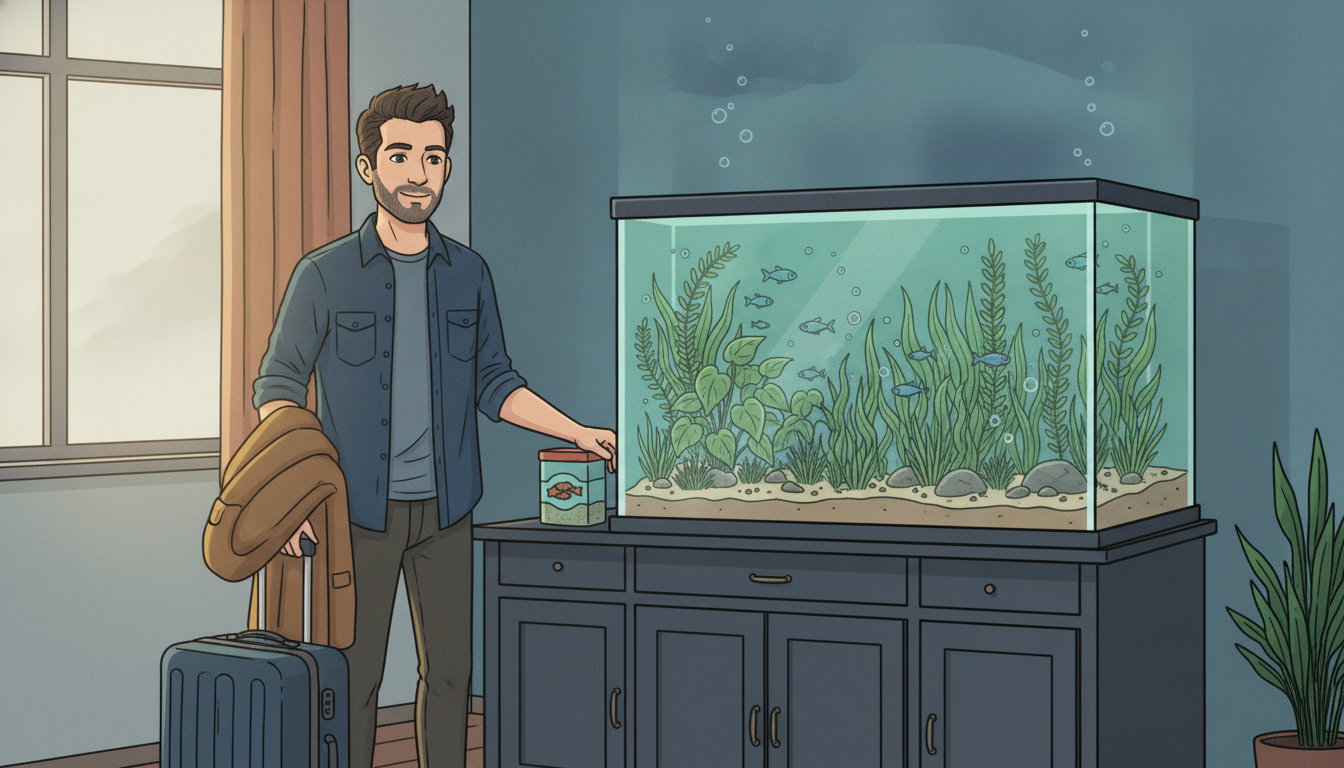
This site sells automation. This is the post where I tell you that for a lot of trips, you don’t need any.
I want to be straight about the conflict, because it’s the whole reason this page is worth reading. Nearly everything else here — feeders, controllers, monitors — starts from the assumption that something has to keep running while you’re gone. For heat and power and water level, that’s true. For food, it very often isn’t, and the device you buy to solve a problem you don’t have is itself a new way to lose a tank.
So let’s do this properly. What happens when the food stops, what the number actually is for your tank, and the specific cases where the answer is “no, arrange feeding” and I’d say so even if it cost me every feeder click on the site.
A fasting fish and a starving fish are not the same animal
Your fish eats, and that food becomes energy, growth, and waste. When the food stops, the body doesn’t just wait. It switches over to what it’s already carrying — and for a healthy adult, it’s carrying quite a lot.
That’s the whole mechanism, and it’s worth saying plainly because the panic around this topic comes from imagining a fish with an empty stomach as a fish in distress. A full-grown fish that skipped three days isn’t in distress. It’s hungry, which is a completely different state, and it’s the normal state of most fish in a river on most days.
The flip side matters just as much. Fasting is a short-term state the body is built for. Starvation is the long-term version, and it does real damage. The Merck Veterinary Manual lists what inadequate nutrition does to fish — “poor growth, deformities, a depressed immune system, hepatic lipidosis, and impaired metabolism” — and names starvation as one of the causes of hepatic lipidosis, a fatty-liver condition it calls “a common problem in captive fish.”
So this isn’t a post telling you fish don’t need food. It’s a post about where the line sits between those two states, because for a stocked adult community tank, the line is further out than a two-week vacation makes you feel.
The number the industry already publishes
Here’s the part that settled it for me, and it isn’t from a forum.
Every ornamental fish in your local store got there in a plastic bag, and the people who ship them have a documented procedure. The University of Florida’s extension service publishes it. Harvested fish go into a holding facility, and they’re deliberately not fed so they clear out their digestive tracts — which keeps the shipping water clean. UF/IFAS puts the time plainly: “Once the fish have had time (1-3 days) to evacuate the wastes in their digestive tracts… they are ready to be shipped.”
Then they’re bagged. The same publication describes bags used to ship ornamental fish “for prolonged periods of time (up to 36 hours).”
Add it up. One to three days with no food in holding, plus up to thirty-six more hours sealed in a bag with no food at all. That’s up to about four and a half days without a meal, on purpose, as routine commercial practice — and then the fish goes into a store tank and gets sold to you as a healthy animal.
That’s not a stunt. It’s the baseline the entire trade runs on. If a fish can do four and a half days inside a shipping bag — cramped, in degrading water, under real stress — it can do a long weekend in your tank with clean water, stable heat, and nowhere to be.
So what’s the answer for your tank?
It depends on inputs you can go check right now, which is why I’m not going to hand you one number. Anybody who gives you a single universal day count hasn’t asked you anything about your tank.
Walk these:
Are they adults? This is the biggest lever by far, and I’ll come back to it below.
How big are the bodies? Merck’s maintenance figure for adult fish is 3% of body weight daily. A bigger fish carries more reserve relative to what it burns, so a tank of adult rainbows and a tank of micro rasboras are not the same question. Small, fast, high-metabolism fish come off the shelf sooner.
How warm is it? Fish don’t hold their own temperature — the water sets their metabolic rate. A tank at 82°F is burning through reserve faster than the same tank at 76°F. If you run warm, shave your estimate.
How heavily, and how recently, is it stocked? A tank that was fully stocked eight months ago is a different system from one you added six fish to last week. New arrivals are still stressed and still establishing; they get less benefit of the doubt.
Is it a mature planted tank or a clean one? This is the quiet one. An established planted tank is covered in biofilm, algae and tiny invertebrates, and a lot of community fish graze on that all day whether you feed them or not. A bare tank with pristine glass offers nothing between meals. Same fish, very different fast.
Is anything already sick or thin? A fish that’s recovering, or one you’ve been eyeing because it looks a bit sunken, doesn’t get a vacation fast. That one needs a sitter or it needs you to shorten the trip.
When the answer is genuinely no
These are the cases where I’d stop reading reassurance posts and arrange feeding, and I don’t think any of them are close calls.
Fry and juveniles. Merck puts adult maintenance at 3% of body weight a day and says fry and fingerlings can take up to 5% — that’s roughly two-thirds more food per gram of fish, every day, in an animal with almost no reserve to draw on. A growing fish that misses meals doesn’t just get hungry, it gets permanently smaller. If you have fry in the house, this question is answered. Get someone in.
Fish that eat tiny meals constantly. Small-bodied, high-metabolism species live close to the edge by design. The reserve math that makes a four-inch adult comfortable for a week doesn’t transfer to something the size of your fingernail.
Anything already unwell. See above.
A tank you stocked recently or stocked heavily. More mouths on the same volume, less margin, and the newest fish are the least settled.
And the one almost nobody thinks about: your cleanup crew. Here’s Merck, on exactly this, and it’s blunter than I expected: “Often, popular bottom-dwelling fish such as loricariids and Corydoras catfish are expected to survive on the leftovers from the other fish. This is not an acceptable practice, and these fish should receive targeted feeding.”
Read that again with a vacation in mind. Your cories and plecos are, in a lot of tanks, already living on a thinner diet than they should be. When you fast the tank, you’re not starting their fast at zero — you’re extending one that was quietly already running. Same goes for snails and shrimp, which at least have the advantage of grazing anything that grows. If your bottom-dwellers are the reason you’re nervous, your instinct is correct, and the fix is a sinking wafer before you leave plus a realistic trip length rather than a feeder aimed at the surface.
The failure you should actually be afraid of
Now the part that reframes the whole decision, because the risk isn’t symmetric.
A tank that misses meals has one failure mode: hungry fish. That’s it. It is recoverable, it is visible the moment you walk in the door, and it’s fixed by feeding them.
A tank that gets overfed by a machine while nobody is home has a different failure mode, and it’s a water chemistry event.
Food nobody eats doesn’t sit politely on the substrate. It rots, and rotting food becomes ammonia. UF/IFAS is clear that in hobbyist systems the feed is the main source of it: “The more feed a fish is fed, the more ammonia the fish will produce.” And it gets worse, because the ammonia on your test card comes in two forms and only one of them is the dangerous one. The same publication: the un-ionized form is “approximately 100 times more toxic to fish than the ionized form” — and the share sitting in that toxic form rises with temperature and pH.
Which is to say: a warm tropical tank is the exact condition that converts an overfeeding into a tissue-damage event rather than a cloudy inconvenience. I ran the numbers properly in the post on tank size, where the same ammonia load lands over UF/IFAS’s damage threshold in a ten-gallon and nowhere near it in a forty. Small tank, warm water, a week of food dumped in one afternoon, nobody home — that’s the real nightmare, and it’s one you have to buy to get.
Note the direction a fast pushes things, too. Less feed in means less ammonia produced. UF/IFAS adds the honest caveat that “even a starved fish will produce some ammonia” — the load doesn’t go to zero — but it drops. A fasted tank’s chemistry drifts the safe way while you’re gone. A fed one drifts the other way and relies on a device not jamming.
That’s the asymmetry. Under-feed and you get a hungry fish. Over-feed and you get a chemistry event in an empty house. When I’m picking gear I’m not trying to make it perfect — I’m trying to make sure that if it fails, it fails toward skipping, which is the whole argument in how I choose an auto-feeder.
By trip length
Assume throughout: healthy adult community fish, mature tank, stable heat, no fry. If you don’t match that profile, go back up a section.
Three days. Feed normally the night before you go and do nothing else. This is not a question. The shipping-bag numbers above cover it with room left over.
A week. Still fine for most established adult community tanks. Do a water change before you leave, check your heater, make sure the lid is on properly, and go. I’d rather you spend the hour on a lid check than on a feeder — an escaped fish or snail is a far more common way to lose livestock than a missed meal is. If you’ve got cories or plecos, drop a sinking wafer in on your way out.
Two weeks. This is where it becomes a real decision rather than a shrug, and where the inputs above start to matter. A heavily planted, lightly stocked, mature tank with big adult fish can do it. A warm, busy, recently stocked tank is pushing it. If you go the feeder route, test it for a full week while you’re still home — and if you’d rather not, a neighbour with pre-portioned doses in a pill organizer is the lower-risk option, because the failure mode of a human is “forgot once” and the failure mode of a jammed drum is “dumped everything.”
Three weeks or more. Arrange feeding. Not because the fish will starve on day fifteen, but because three weeks is long enough that something else goes wrong — a heater sticks, a filter clogs, the power blinks — and the value of a person in the room has nothing to do with food by that point.
One more thing, for every week of the year
The routine one-day fast is worth adopting whether you travel or not.
Pick a day, skip it, and the tank’s digestive load and nitrogen input both drop for twenty-four hours. It costs nothing, it’s well within what any healthy adult fish handles without noticing, and it quietly makes you better at this — because once you’ve watched your fish skip a Tuesday and behave completely normally on Wednesday, the two-week question stops feeling like a gamble and starts feeling like a calculation.
The confidence is the actual deliverable here. Not a number.
Go check your heater instead.