How to Get Rid of Pond Snails Without Chemicals
September 24, 2026
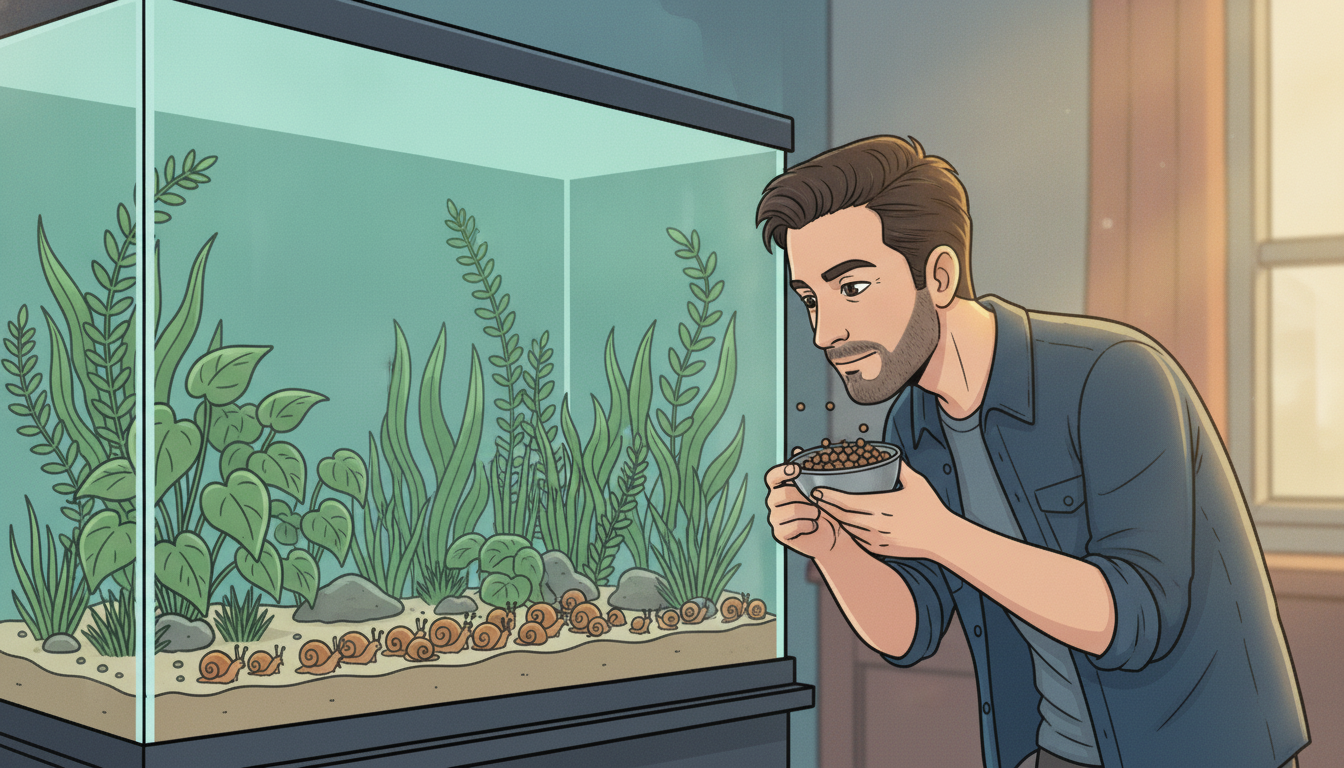
I counted thirty-one bladder snails on the front glass of my 75-gallon one morning, before coffee, while the light was still on its sunrise ramp.
The snails weren’t the interesting part. The number was.
Here’s what nobody tells you when you go looking for how to kill them: a pest snail population is not a random event, and it isn’t bad luck. It’s a measurement. Your tank quietly counts how much food goes in that nothing eats, and it reports the answer in snails. Kill the snails and you’ve smashed the gauge. You haven’t touched the thing it was measuring.
So let’s do it the other way around. Read the number, then fix the input. No copper, no predator, nothing to buy.
Where they came from, and why that’s the wrong question
They came in on plants. Almost always. A new stem plant, a clump of moss, a tissue-culture pot that wasn’t as sterile as the label suggested — somewhere in there was a snail the size of a grain of sand, or a clear jelly blob of eggs stuck to the underside of a leaf.
One is enough. Bladder snails are simultaneous hermaphrodites, which means every adult has working male and female parts and a lone snail can fertilise its own eggs. There is no “I only got one, so I’m fine.”
But this is the wrong question, and it’s the question every other page spends four paragraphs on. How they arrived explains the first snail. It explains nothing about the four hundred you have now.
Which one do you actually have?
Three different animals get called the same thing. Telling them apart takes about ten seconds.
Bladder snail. Hold the shell with the pointed tip up and the opening facing you. If the opening is on the left, it’s a bladder snail — they coil the opposite way from almost every other snail you’ll meet. Thin, thread-like tentacles. Thin, amber shell you can nearly see through. Tops out around 16 mm, and most never get close. No trapdoor on the foot.
Pond snail. Same test, opening on the right. Taller, more pointed spire, heavier and darker shell, and short broad tentacles instead of threads. Gets noticeably bigger than a bladder snail.
Ramshorn. Unmistakable — the shell is a flat coil lying on its side, like a tiny cinnamon bun. Here’s the odd part: ramshorns carry oxygen in their blood with haemoglobin, the same iron-based molecule we use, which is why the bred red ones actually look red. Most snails run on a copper-based protein instead and have pale bluish blood. It’s a strange bit of biology and it makes for a good aside at the fish store.
Does the difference change your plan? Barely. All three graze the same stuff and all three respond to the same fix. Which is exactly the point I’m about to make.
The math, which is the whole post
Take one adult bladder snail. It breeds year-round and lays somewhere between 50 and 100 eggs a week. Those eggs hatch in 15 to 20 days. The hatchlings are ready to breed with another snail at five to seven weeks old.
Sit with that for a second. Fifty to a hundred a week, each new batch joining in a month and a half, with no season and no pause.
Now run it forward on paper with nothing holding it back. One snail on day one is a few hundred by week six and a few thousand by week ten, and somewhere past that the number stops being a number and starts being a joke. Within a year a single hitchhiker with unlimited food would fill your living room.
Your tank has forty. Or three hundred. It does not have three hundred million.
So something is capping it, and that something is food. Bladder snails are scrapers. They drag a rough little tongue across surfaces and take algae, diatoms, biofilm, softening dead leaves, and whatever fell past the fish and landed in the gravel. Every item on that list is surplus — organic matter nothing else in the tank was going to use.
That’s the mechanism, plainly: the population settles exactly where the surplus runs out. It isn’t a plague. It’s a float valve. The number on your glass is your leftover food, converted into snails, displayed where you can see it from across the room.
Which makes the number genuinely useful. A scattering of snails says your feeding is roughly right. A front pane you can’t see the fish through says you’re putting in meaningfully more than the tank consumes — and if this is a tank you plan to leave running for two weeks, that is something you want to know before you’re at the airport.
One honest correction to how this usually gets explained. “Snails only eat what your fish didn’t” is close but too narrow. They also eat algae and biofilm, and algae runs on light and nutrients, not on your feeder. So a bloom can also mean your photoperiod drifted long — I’ve written up the lighting side of that separately. Uneaten food is still the biggest input you directly control, and it’s the one to check first.
Why the predator costs more than the snails
Assassin snails are the recommendation you’ll get in every forum thread. They work, in the narrow sense that they eat pest snails. Here’s the rest of the receipt.
They don’t read labels. A snail-eating snail eats snails. Not the ones you dislike — snails. Small and slow is the whole selection criteria, which covers baby nerites, baby mystery snails, and anything else you were hoping to breed. You can’t buy a predator that shares your opinions.
They breed too. Slowly, granted: separate males and females, eggs laid one at a time in little clear capsules glued to hard surfaces, three to eight weeks to hatch, and the babies bury into the sand for months before you see them again. Slow isn’t never. You’ve traded a population you can see for one you can’t.
When they win, you start feeding them. They’re carnivores. Once the pest snails are gone, keeping them alive means dropping protein food into the tank on purpose. Read that against everything above: you’ve closed the loop in the wrong direction and gone back to adding surplus, only now it’s deliberate.
And the first visible result is often snails leaving the water. A pest snail’s response to a predator is to head up — to the waterline and past it, plus burrowing, clamping down, and letting go to float. So the early days of an assassin-snail experiment can look like snails on your rim and on your floor. If that’s already a live issue for you, I’ve covered lids and gaps in detail elsewhere and won’t repeat it here.
There’s a smaller detail I like, because it shows how thoroughly the strategy misses. Researchers measuring bladder snail shells have found they grow thicker when predators are in the water — one 2010 study put the range at 0.15 to 0.35 mm depending on predator cues. The survivors armour up. You’ve applied pressure to an animal that is extremely good at being under pressure.
Why the chemical costs more than the snails
The other aisle is chemical. Most things that reliably kill snails in a tank come down to copper, which is also the active ingredient in a long list of fish medications labelled unsafe for invertebrates.
The University of Florida’s extension publication on copper in aquarium and aquaculture systems is not subtle about what copper does. Three lines from it are worth having in front of you:
- “Most invertebrates are highly sensitive to copper and will not survive a copper treatment.”
- Invertebrates shouldn’t be returned until free copper measures 0.01 mg/L or less, and ideally zero.
- “Copper is also toxic to the nitrifying bacteria in the biofilter. At 0.3 mg/L Cu2+, copper sulfate inhibits ammonia and nitrite oxidation.”
Read that third one again with this site’s whole premise in mind. The bacteria that convert ammonia into something harmless are the single reason a tank can be left alone for two weeks. A treatment that stalls them isn’t a snail solution — it’s a direct hit on the margin the tank actually runs on.
The same publication notes that copper binds to substrate and decorations and can be released back into the water later if pH drops. Your gravel remembers.
Then there’s the die-off. Three hundred snails that die on a Tuesday do not leave the tank. They rot in it. That’s a substantial load of decaying matter hitting the water at the exact moment your filter bacteria are impaired, which is the failure mode this entire site exists to design around. You wanted fewer snails. What you bought was an ammonia spike, a wounded biofilter, dead nerites, and substrate that can hand the copper back to you a month later.
Turning the feeder down without starving anything
This is where “just feed less” falls apart, because the people saying it are mostly hand-feeding. A tank built to run itself has an auto-feeder on it, and a drum feeder does not understand “less.” You have to calibrate it.
Measure one portion before you change anything. Run the feeder dry over a white saucer, five turns, and look at what’s actually in the pile. Most people have never seen a single portion by itself, which means they’ve never really known what they’re dosing. I walk through the whole plate test in the auto-feeder post.
Cut portion size before you cut meals. Narrow the slider a little and keep the schedule. Several small meals suit most community fish better than one big one, and shrinking the portion is the change that touches the surplus without touching the routine.
Change one thing, then wait two weeks. Eggs already laid still hatch, 15 to 20 days out. Adjust the feeder on a Monday, judge it the following Monday, and you’ll decide nothing works and go buy copper. The population responds on a generation’s delay. Give it one.
Watch the fish for the first week, not the snails. Thin bellies, fish still hunting the substrate long after a meal, colour going flat — back it off a notch. Fish are the fast gauge. Snails are the slow one. Use both.
Manual removal, and why it’s worth the effort
Here’s the part that makes netting snails out more than a tidying job: you’re not removing snails, you’re removing the surplus. Each snail is a small package of the nutrients that came in as fish food. Taking them out of the tank is nutrient export — the same job a water change does, in a different container.
The trap is a piece of blanched vegetable. Zucchini, cucumber, or a lettuce leaf: thirty seconds in boiling water, then straight into cold, which softens it and makes it sink. Weight it down or clip it, put it in after lights-out, and lift the whole thing out in the morning with the snails riding on it. Do that three or four nights running and you’ll be startled how much comes out.
Two rules, both for the same reason. Don’t leave the vegetable in past morning — past that it’s just another meal rotting into the water, and you’ve fed the problem you’re fixing. And don’t crush snails in the tank. Same math. A crushed snail is surplus you paid for twice.
If you’d rather skip the vegetable: they cluster on the glass and under the rim after dark. A cup and five minutes with the lights off is unglamorous and it works.
The number worth leaving alone
My honest position is that the right number isn’t zero.
A modest pest-snail population is a working part of a low-intervention tank. They get to leftover food before it rots, keep diatoms off the glass and the hardscape and the plant leaves, turn over the top layer of substrate, and — the part I actually value — they run a free, continuous, always-on report on how well-fed your system is. Nobody sells a sensor that does that.
What you want is a number that’s stable and low enough to see the fish through. Stable at forty? Leave it alone. Doubling over a month? Something changed. New food, a heavier hand, more light, or a fish that died behind the driftwood and is quietly feeding the whole colony. Go find it.
Zero is achievable. It costs you a predator, a chemical, or a tear-down, and in every case you’re paying with the health of the thing you built.
The snails didn’t break your tank. They counted for you, honestly, for free, in a unit you can read from the doorway. Turn the portion down, pull a few hundred out on a piece of blanched zucchini, wait two weeks, and count again.
That number is the only review your feeding routine will ever need.