Aquarium Leak Detectors: Where to Put Them, and Which Kind Still Works When Your Wi-Fi Doesn't
September 26, 2026
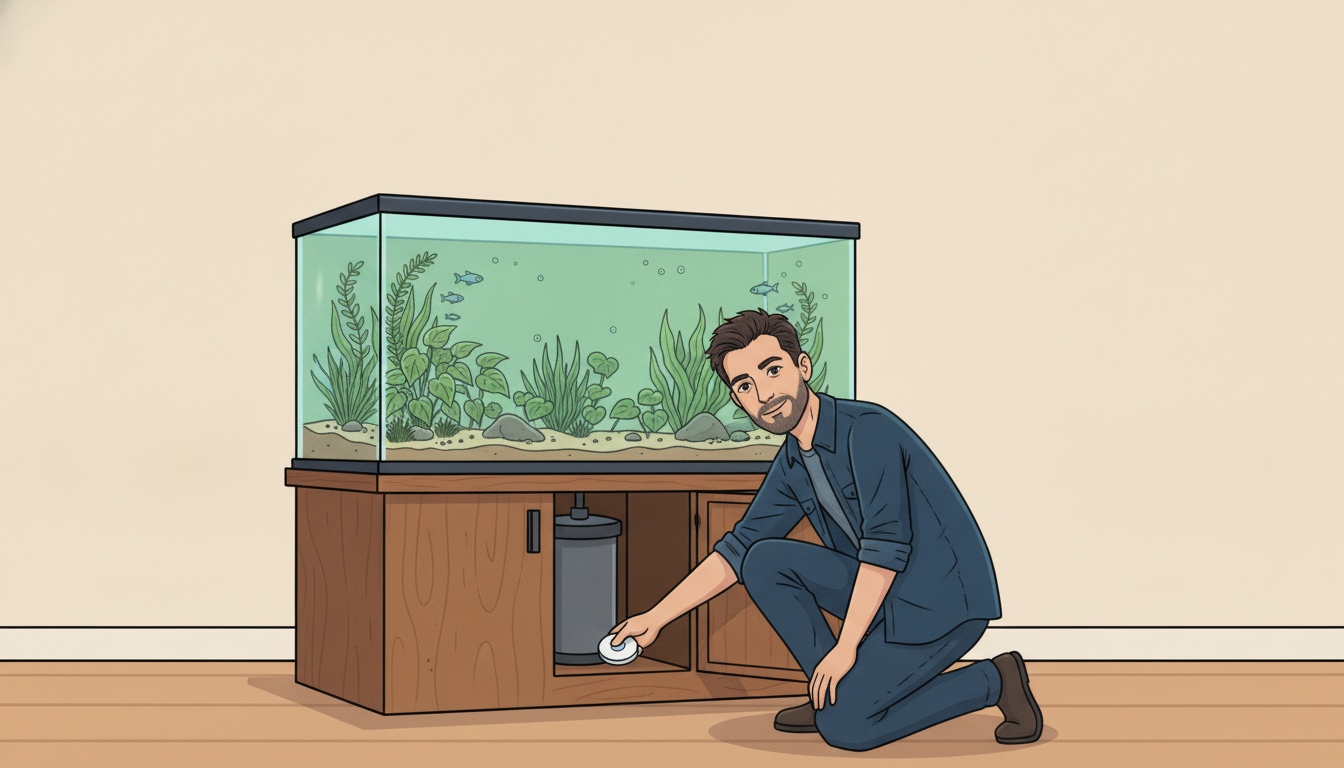
Take an inventory of what’s watching your tank right now.
A heater controller with its own probe. Maybe a second thermometer auditing the first one. A float switch in the top-off reservoir, a Wi-Fi monitor pushing temperature to your phone from three time zones away, an auto-feeder that logs its own feedings.
Every one of those is watching the water on the inside of the glass.
Which is fine, because that’s where the fish are. But the failure that costs the most money on this entire site isn’t in there. It’s the water that gets out — down the back of the stand, into the cabinet floor, through the seam where the laminate meets the subfloor, and into the ceiling of whatever room is underneath.
The fish survive that one. The floor doesn’t.
The number that makes this worth twenty-five dollars
I’ll use insurance data rather than a horror story, because the horror stories online are all unverifiable and the data isn’t.
The Insurance Information Institute publishes homeowners loss figures from ISO. Over 2019–2023, the “water damage and freezing” category ran an average claim severity of $15,400, at a frequency of 1.50 claims per 100 policies a year. In 2023 it was 22.6% of all homeowners claims — second only to wind and hail.
Now, be honest about what that number is. It’s a category average that includes burst supply lines and frozen pipes running unattended for days, which is a worse event than anything your aquarium can do. Your tank is not going to average a fifteen-thousand-dollar claim.
But your tank can absolutely produce a several-thousand-dollar one, and the sensor that would have caught it costs about as much as a bag of decent shrimp pellets. That’s the whole argument. It isn’t that a leak is likely. It’s that the ratio between what it costs to detect and what it costs to miss is more lopsided than anything else you can buy for a tank.
How much water can actually get out? Do the math.
This is the part that decides where the sensors go, so it’s worth two minutes with a calculator instead of a vibe.
1. The canister siphon — by far the biggest number
A canister filter sits below the tank and runs on siphon. That’s the whole design. Which means if a hose walks off a barb, or an o-ring gives up, or you close the cabinet door on the intake line, the tank doesn’t leak a bit — it siphons, and it keeps siphoning until the water level reaches the mouth of the intake and air breaks it.
So the size of your worst-case spill is not a mystery. It’s the volume between your normal waterline and the bottom of your intake strainer.
Here’s a standard 75-gallon, which is 48 by 18 inches of footprint. One inch of depth is 48 × 18 = 864 cubic inches, and there are 231 cubic inches in a US gallon. So every inch of water in that tank is about 3.7 gallons — call it 31 pounds.
If your intake strainer hangs six inches below the surface, a failed siphon puts roughly 22 gallons on your floor. On a 40-breeder (36 × 18) it’s 2.8 gallons an inch. Measure your own footprint, measure how deep your intake sits, multiply.
Two useful things fall out of that. First, you now know whether this is a towel problem or a drywall problem. Second — and this is free — raising the intake strainer reduces your worst case directly. Every inch you move it up is 3.7 gallons that can’t leave a 75. Most people hang it low out of habit. There’s usually no reason for it to be more than a few inches under.
2. The top-off reservoir — bounded, but bounded by you
If you run an auto-top-off, the reservoir is the second source, and its maximum is easy: it’s the reservoir. A 5-gallon jug can put five gallons on the floor and not a drop more.
I’ve written the prevention side of this in detail — siphon breaks, run-time watchdogs, and sizing the jug so it can’t out-volume the tank — so I won’t redo it here. The short version for this post is that the reservoir is the one leak source where the fix is a smart plug, because a pump is an electrical device and cutting its power actually stops it. Hold that thought.
3. The slow weep — smallest rate, longest run, worst outcome
A seam that weeps, a hose clamp that seeps, condensation running down a cord and dripping off the loop — none of these make a puddle you’d notice in an afternoon.
Give it two weeks, though.
A drop is conventionally about a twentieth of a millilitre. One drop per second is 86,400 drops a day, which is roughly 4.3 litres — a bit over a gallon — every day. Over a fourteen-day trip, sixty litres. Sixteen gallons, delivered one drop at a time, all of it into the same square foot of floor.
That’s the one that ruins a subfloor, because the damage isn’t volume, it’s duration. Fast floods get mopped. Slow ones get absorbed.
It’s also the one a sensor is best at, because a slow leak has nowhere to go but down, and down is exactly where you put the sensor.
Where the two sensors actually go
Two is the right number for one tank. Here’s where.
Sensor one: the cabinet floor, at its lowest corner. Not on a shelf. Not on top of the canister. Not on the little raised lip at the front of the stand. On the deck of the cabinet, in the corner the water will actually reach.
Which corner is that? Don’t guess — pour a cup of water in there and watch. Cabinet floors are almost never level, because stands aren’t shimmed to the fraction and floors aren’t flat, and a cup of water will find the low corner in about four seconds. That’s your spot. Wipe it up and put the sensor there.
This single step is the difference between a sensor that works and a sensor that’s decoration, and it’s the one nobody does.
Sensor two: the floor outside, at the stand’s low side. Same logic, one level out. This one catches anything that escapes the cabinet, plus water running down the outside of the stand from a top-edge overflow or a splash you didn’t see. Find the low side the same way. If your stand sits on carpet, put the sensor on the hard floor just past the carpet edge, because carpet will wick water sideways for a long time before it pools anywhere a probe can find it.
If you run a remote ATO reservoir, it gets its own. A jug sitting in a different cabinet is a separate water source with a separate failure, and the sensor under your tank will never hear about it.
Two placement mistakes worth naming
Anything under the sensor is a problem. A folded towel, a rubber mat, a drip tray with a lip — they all lift the probes above the water they’re supposed to find. If you like a tray under the canister, that’s fine, but put the sensor inside the tray, not next to it.
Don’t put it where a water change splashes it. A sensor that false-alarms every time you do maintenance is a sensor you’ll mute. And a muted sensor is an expensive paperweight that you will absolutely forget to un-mute the week you fly out. Either move it out of the splash zone or make un-muting the last line of your pre-trip list.
Wi-Fi, base station, or neither — and what happens when the router dies
All three of these will scream locally. That’s the only behaviour every one of them shares, and it’s worth nothing if the house is empty.
The part that matters for a tank you’re leaving is the path between the sensor and your phone, and there are three shapes of it.
Direct Wi-Fi. The sensor joins your 2.4 GHz network itself. Nothing else to buy, which is genuinely nice. The catch is physics: your sensor is sitting on the floor of a wooden cabinet, behind and below a box holding several hundred pounds of water, and water is very good at absorbing 2.4 GHz. It works fine when the router is in the same room. It gets unreliable fast when it isn’t.
Base station. The sensors use their own low-power radio to reach a small base, and the base handles the internet from somewhere with good signal — usually plugged in near the router. X-Sense rates that sensor-to-base link at up to 1,804 ft, which is a spec you’ll never use in a house and that’s the point: you’re spending all that margin on getting out of the cabinet. The other thing I like here is that the base station sounds too, at 120 dB, which means a housesitter or a roommate upstairs hears the alarm without anybody reading a notification.
Long-range (LoRa). Worth knowing this category exists. YoLink’s Water Leak Sensor 4 uses LoRa instead of Wi-Fi; on their own product page they claim up to a quarter mile open-air, 5+ years on two AAAs, a 105 dB sounder, top and bottom electrodes, and device-to-device pairing that can trigger another YoLink device with no internet, no app, and no AC power. That last feature is the most interesting thing in this whole category. I’m not putting a buy-link on it, because I couldn’t find a clean current listing for the single sensor — an Amazon search for it surfaces ultrasonic water meters and whole-house shutoff kits first, and I’m not sending you to the wrong box. Buy it direct if you want it.
And now the honest part. None of this reaches you during a power cut. The sensor is on batteries, so it’ll still scream into your empty house, but your router isn’t, and no push notification survives a dead router. If you want leak alerts that hold through an outage, the router and modem need to be on a UPS — which is the same conversation as keeping the rest of the tank alive when the power goes, and you should solve it once for both.
What an alarm cannot do
It cannot stop water. Nothing on this page stops water. Be clear-eyed about that before you feel protected.
What it can do is convert one kind of problem into a much cheaper kind. Water on a floor for ten minutes is a towel. Water on a floor for nine days is flooring, underlay, subfloor, and a conversation with an adjuster. An alarm doesn’t prevent the leak; it collapses the duration, and duration is where almost all of the cost lives.
So pair it with something that can act.
For a pump, use a smart plug. SwitchBot’s own listing says to pair their leak sensor with their Plug Mini to cut power to the leaking appliance automatically, and for a top-off pump that’s stuck on, that’s exactly the right response. I’d set that up and then not fully trust it — I haven’t been able to confirm whether that automation runs locally or through the cloud, and if it’s the cloud, it goes away with your internet. Treat it as a good second layer, not the plan.
For a canister, the smart plug doesn’t save you, and this is the bit I’d most want you to take away. A siphon is gravity, not electricity. Cut power to a canister mid-leak and the pump stops, but water keeps running out of the tank until the level hits the intake. Your defence there isn’t a plug. It’s the intake depth you measured earlier, and a physical shutoff you turn by hand.
And pair it with a person. The real output of a leak alert is a phone call to whoever has your key. Before a trip, that person should know they might get a text that says go look under the tank, and they should know where the valves and the plugs are. An alarm with nobody on the other end of it is just a more expensive way to find out later.
Test it monthly, and test the right half
Wet a paper towel and lay it across the probes.
Two things should happen: the unit sounds, and your phone gets a notification. Most people test the first one, hear the beep, and stop. The siren almost never fails. The notification path is what silently breaks — a router got replaced, the app logged you out, the sensor dropped off the network in March and nobody noticed.
So test until the phone buzzes, not until the sensor beeps.
Do it monthly, check the battery indicator while you’re down there, and do one more run as part of your full mock-vacation week before a trip. If the alarm is going to be part of your travel plan, it has to pass the same rehearsal everything else does.
What I’d buy
If your tank is in the same room as your router, the four-pack of direct Wi-Fi sensors is the easy call — two under the tank, two anywhere else in the house you’ve been meaning to cover.
If the tank is in a basement or across the house, buy the base-station kit instead. You’re paying a little extra for the one thing that actually matters, which is a radio link that gets out of a wooden cabinet full of water.
Either way, add the smart plug if you run a top-off pump, and spend the cup of water finding your low corner before you stick anything down.
Twenty-five dollars and ten minutes, against the ceiling of the room below. I’ve bought worse insurance.